To Colour….

By Sarah Evelyn Marsh

As part of Sensory Spaces: An Autism Friendly Project, I ran two sessions exploring the theme of colour. The first was rather abstract, I asked questions such as; What does colour smell like? What does colour feel like?

For a child on the autistic spectrum, a question like this may be confusing, some autistic people think and understand literally. So instead of directing these questions at the children, I answered and speculated on them myself. These abstract questions became vehicles for the workshops documented below.

To Colour... by Sarah Evelyn Marsh
Colour, light, shadows


Colour and senses

I created a ‘colourful smells’ area by attaching bright flowers to ribbons and filling fabric pouches with herbs and spices. A simple chart of coloured paper allowed the children to match the smells with colours. Pepper was matched to black and some purple flowers were matched to the colour purple. Perhaps with another set of children the outcomes would have been different and less literal, but the group engaged with the task, considered basic colour theory and recognised smells. The children made decisions and developed their sorting and matching skills.

To Colour... by Sarah Evelyn Marsh
Colour and senses


We ate slices of colourful, juicy, fruits such as, melon, orange, kiwi, and strawberries. Closing our eyes we thought about how the fruit tasted and felt, through emotions and sounds. Where possible, we described the sensations verbally.

To Colour... by Sarah Evelyn Marsh
Tasting colour


To Colour... by Sarah Evelyn Marsh
Feeling colour


To Colour... by Sarah Evelyn Marsh
Tasting colour composition

We viewed the world through coloured lenses. Red was always the most popular colour. I wonder why this is? Perhaps because it’s such a vibrant colour. Does it make people feel safe, warm or powerful, like a superhero? Is red the most emotive and evocative colour? Try looking through colour filters and see how they make you feel.

My wonderful assistant and translator, Monika Gorska, helped me create the flower glasses. Putting on a pair of these unique specs heightened our senses, we could sniff our way around the space, the petals felt cool on our skin, (sometimes they tickled, and thankfully no one suffered from hay-fever)! They were such a genius creation and inspired us to develop further sensory-inspired wearable objects.

To Colour... by Sarah Evelyn Marsh
Flower glasses


To Colour... by Sarah Evelyn Marsh
Weighted glasses

Handmade kaleidoscopes encouraged the children to create moving patterns from the colourful objects we explored in our sessions. All you need is some strips of plastic mirror taped together in a triangular tube, I added extra layers of texture by wrapping them in super, soft velvet.

To Colour... by Sarah Evelyn Marsh
Kaleidescopes


To Colour... by Sarah Evelyn Marsh
Kaleidescope eyes


Colourful food dye in salt dough worked a treat (just be aware of some children wanting to eat all the dough)! We were able to mix colours, develop fine motor skills and make whatever we wanted.

To Colour... by Sarah Evelyn Marsh
Colour and salt dough


To Colour... by Sarah Evelyn Marsh
Colour and light

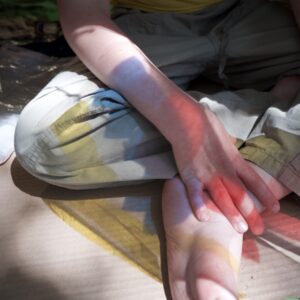
Using an old overhead projector, we were able to physically immerse ourselves in colour, bathing in the light and gentle heat. The colour wrapped around our bodies, reflected onto our skin and cast dramatic shadows on the walls, floor and ceiling.

To Colour... by Sarah Evelyn Marsh
OHP and colour


To Colour... by Sarah Evelyn Marsh
Wrapped in colour


To Colour... by Sarah Evelyn Marsh
Colour and movement


Colour and music go hand in hand, both are emotive forms of creative language. When I incorporate music into a session I can alter the mood from bright, animated vibrancy to a calm sea of tranquility. Consider, what sounds do colours make? Can you connect certain forms of music to different colour palettes. What happens when you take all the colour away? What do black and white sound like? Have fun with your ideas, explore new music genres and create soundtracks for your lessons.

Tip: Play the music through something that the children can control, allow them to switch it on and off. Use visual signs where needed.

To Colour... by Sarah Evelyn Marsh
Immersive colour


Through discussions with parents of children with autism, I have developed the confidence to be more adventurous with the planning of my projects. As long as I feel safe and confident about what I’m leading then I think it’s great to take risks, that’s how we learn! If you’re not sure what will happen, then give it a go…

See more posts from Sarah in this series by following this link: Sensory Spaces: An Autism-Friendly Project

evelynarts.moonfruit.com – work portfolio

evelynartsunique.com  – online shop


This is a sample of a resource created by UK Charity AccessArt. We have over 1500 resources to help develop and inspire your creative thinking, practice and teaching.

AccessArt welcomes artists, educators, teachers and parents both in the UK and overseas.

We believe everyone has the right to be creative and by working together and sharing ideas we can enable everyone to reach their creative potential.


The AccessArt Village and How a Small Idea can be Big

See how primary school pupils responded to the AccessArt Village in Mansfield Central Library

This was a very special day for Sheila Ceccarelli from AccessArt, as she got to meet and work with sixty, year five pupils from Berry Hill Primary School in Mansfield Central Library, with colleagues from Inspire Arts Service, who had previously facilitated the development of the AccessArt Village across Nottinghamshire.

Making an Ink and Wax Village with Pupils in Mansfield

This was a very special day for Sheila Ceccarelli from AccessArt, as she got to meet and work with sixty, year five pupils from Berry Hill Primary School in Mansfield Central Library, with colleagues from Inspire Arts Service, who had previously facilitated the development of the AccessArt Village across Nottinghamshire.


Day of the Dead Skulls


One Material: Sea Sculptures from Plastic Bottles


Exploring the Sculptural Possibilities of Plastic Milk Bottles


Drawing Soft Toys Inspired by “Where the Wild Things Are” by Maurice Sendak

See This Resource Used In Schools…

Sarah's Saturday Art Club

You May Also Like…

Pathway: Drawing and Making Inspired by Maurice Sendak

Drawing feathers

This resource is featured in the ‘Drawing and Making Inspired by Maurice Sendak’ pathway

Visual Arts Planning Collections: Toys, puppets, dolls

Puppet showing the hands

talking points: maurice sendak

Close up copies of images of Where the Wild Things Are by Maurice Sendak


Working with Ink


Magnets and Forces


Two and Four Legged Creatures


The Opposite of Light


Snowflakes


Making your Mark on Small Canvases


Making a “To Scale” Gallery


Installing Artwork in “To Scale” Gallery


Draw, Paint, Build, Make: Gallery Project


Sensory Spaces: An Autism-Friendly Project

To Connect


At the beginning of the project it was important to take time getting used to each other, the learning space and the surrounding environment. Below is a list of considerations you may find helpful to use in your own learning spaces. Be aware of the daily sounds, smells and other textures of life in your learning space; a constant humming noise or flickering light may be stressful for a child with autism. Allow time for everyone to feel their way in the space; connections may be made through the use of different senses and body parts.

At the beginning of the project it was important to take time getting used to each other, the learning space and the surrounding environment. Below is a list of considerations you may find helpful to use in your own learning spaces. Be aware of the daily sounds, smells and other textures of life in your learning space; a constant humming noise or flickering light may be stressful for a child with autism. Allow time for everyone to feel their way in the space; connections may be made through the use of different senses and body parts.

To Conceal


During the six week project, the group explored different themes and actions, some of these were displayed through learning schemas. In week 2 we experimented with different ways to conceal ourselves and objects; schemas such as enveloping and enclosure were exhibited by the group.

During the six week project, the group explored different themes and actions, some of these were displayed through learning schemas. In week 2 we experimented with different ways to conceal ourselves and objects; schemas such as enveloping and enclosure were exhibited by the group.

To Colour

Two of the sessions explored the theme of colour. The first was rather abstract, I asked questions such as; What does colour smell like? What does colour feel like?
For a child on the autistic spectrum, a question like this may be confusing, some autistic people think and understand literally. So instead of directing these questions at the children, I answered and speculated on them myself. These abstract questions became vehicles for the workshops documented below.

Two of the sessions explored the theme of colour. The first was rather abstract, I asked questions such as; What does colour smell like? What does colour feel like?
For a child on the autistic spectrum, a question like this may be confusing, some autistic people think and understand literally. So instead of directing these questions at the children, I answered and speculated on them myself. These abstract questions became vehicles for the workshops documented below.

To Construct


In my final post on the project, I want to reflect on the theme of To Construct… looking at the different ways we constructed during the project. Please remember this is a personal and artistic reflection, based on the ideas I presented and the (emotional and physical) reactions and responses of the children and their families, who inspired changes and the development of the project as we experienced it.

In my final post on the project, I want to reflect on the theme of To Construct… looking at the different ways we constructed during the project. Please remember this is a personal and artistic reflection, based on the ideas I presented and the (emotional and physical) reactions and responses of the children and their families, who inspired changes and the development of the project as we experienced it.


To Conceal….

You May Also Like…

Talking Points: Linda BEll


Explore how Linda Bell creates sculptures


Explore how Linda Bell creates sculptures

Talking Points: Nnena Kalu


Explore artist Nnena Kalu


Explore artist Nnena Kalu


Composite Still Life Studies in Candlelight


The Winter Tree Challenge: A Combined Sculpture & Drawing Project!


Making an Ink and Wax Village with Pupils in Mansfield