A collection of sources and imagery to explore the work of Samantha Bryan.
This resource is free to access and is not a part of AccessArt membership.
Please note that this page contains links to external websites and has videos from external websites embedded. At the time of creating, AccessArt checked all links to ensure content is appropriate for teachers to access. However external websites and videos are updated and that is beyond our control.
Please let us know if you find a 404 link, or if you feel content is no longer appropriate.
We strongly recommend as part of good teaching practice that teachers watch all videos and visit all websites before sharing with a class. On occasion there may be elements of a video you would prefer not to show to your class and it is the teacher’s responsibility to ensure content is appropriate. Many thanks.
Samantha Bryan
“Working from her garden studio in Mirfield, West Yorkshire, Samantha Bryan has produced a new body of work for her exhibition at YSP celebrating 20 years of making. Known for creating distinctive figures, she has gained a worldwide cult following.
For two decades Bryan has been making humorous yet industrious fairy-like creatures; adorned with items from her eclectic hoard of buttons, spotted feathers, seed pods, dyed leathers, and contraptions influenced by Victorian flying machines. She combines these materials and found objects to inform their intriguing personalities.” – Yorkshire Sculpture Park
Introducing the BAAV Blimp
Brain’s Ariel Application Vehicle is a new cutting edge tool welcomed by the Fairy Dust Industry. This aircraft can do in minutes what it would take ground-based workers days to complete. Its increased capacity makes dust spreading incredibly efficient. It’s hopper can hold 120 pounds of dust and can sprinkle around 80 acres per hour. Revolutionary for fairy life.
51 x 41 x 21cm (w,h,d) 2022 Image: Red Photograpgy
Introducing… Brain’s Bottom Warming Garments for fairies. Vital for high altitude flying. 36 x 12cm x 10cm (h,w,d) 2022 Image: Joanne Crawford
Fairies often find themselves flying at high altitude. A dangerous pursuit with its many risks. The most obvious and most disastrous outcome would be ‘wing or limb freeze’. The consequence of which is high speed plummeting fairies. This is easily preventable if body temperature is maintained.
Brain’s Crash Helmet, designed specifically for accident prone fairies…
36 x 12cm x 10cm (h,w,d) 2015 Image: Jess Petrie
The clumsier variety of fairy would always be advised to wear a crash helmet rather than a standard issue helmet. The Crash Helmet offer greater head coverage and substantial inner padding for increased protection.
The fairy is wearing a tan leather flight suit, hand stitched with patch detail. It stands securely on a wooden base that can be easily mounted on the wall should you wish to do so. It features a typed label and is signed on the reverse
Brain’s Dust Distribution Vehicle (Glider)
35 x 31 x 35cm (w,h,d) 2014 Image: Edward Chadwick
Designed to enable a busy fairy to spread dust easily and efficiently
Questions to Ask Children
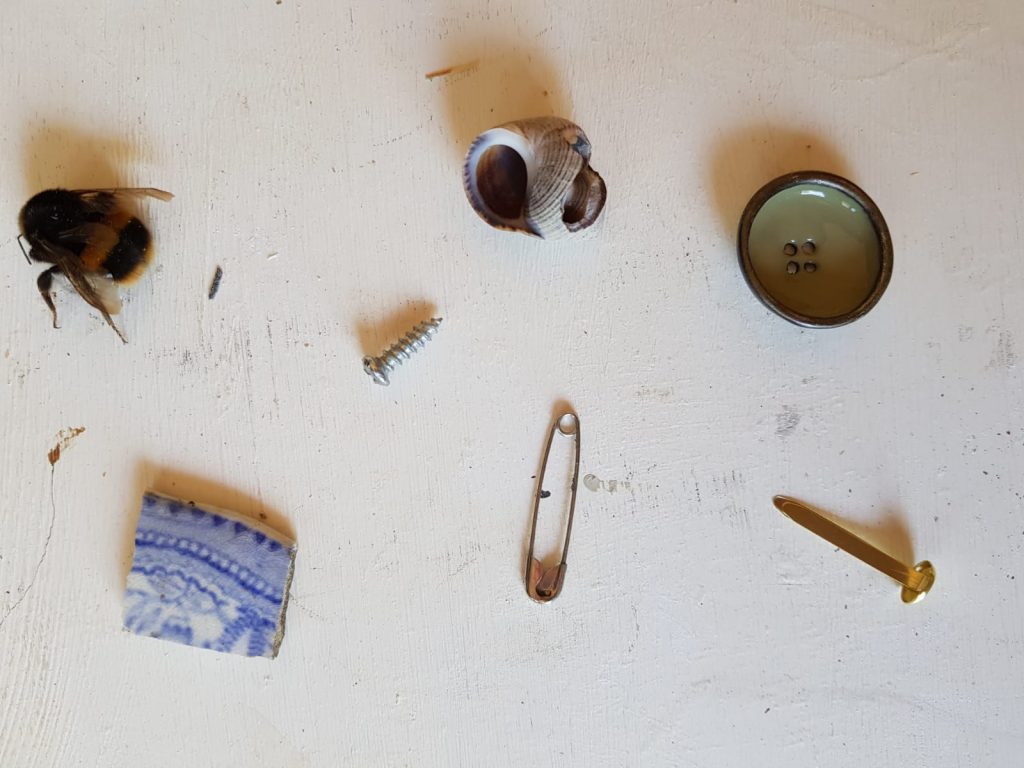
What objects can you see in Samantha’s fairies and inventions?
What do you like about the fairies and why?
Which fairy is your favourite and why?
How has Samantha created personalities for the fairies? Consider accessories, outfits and props.
Do you think the personality grows as she creates the fairies or she plans it in advance? Why?
If you were going to design a fairy based on you, what personality traits might it have? And how could you highlight those traits through accessories, outfits and props?
Our Creative Community: Finding Exhibitions Near You
Our Creative Community: Curating an Exhibition Part One
Our Creative Community: Curating an Exhibition Part Two
Our Creative Community: Tips for Organising an Exhibition Setting
Our Creative Community: Plates Inspired by Janine Burrows
Our Creative Community: Inspired by Samantha Bryan Part One
Our Creative Community: Inspired by Samantha Bryan Part Two
Our Creative Community: The Island: A Thinking Skills Workshop
Our Creative Community: Finding Artists In Your Community
CPD Recording: Sketchbook Share
You May Also Like…
see all sketchbook resources
The Sketchbook journey
Sketchbook pedagogy
Our Creative Community: Top Tips for Facilitating an Island Thinking Workshop
Our Creative Community: Preparing Screens
Our Creative Community: Inspired by Nigel Hoyle
Our Creative Community: Yorkshire Sculpture Park Visit
The Everyday School of Art
This is a duplicated post, available on both AccessArt and The Everyday School of Art, to explain the thinking behind a new Substack venture aimed at creating a shared space to inspire personal creative exploration.
Creative cycles ebb and flow. There are times in your life when creative thought and action feels important and becomes all encompassing, and times in your life when leaving behind the pressure to create is a welcome relief. And then times in your life when you know creativity is part of you, but it seems to exist just behind or just in front of you, never quite with you now.
I’ve always been interested in why we are creative beings, and how we enable our creativity to flourish. For many years, as a child, teenager and young person, this manifested itself as a desire to actually make – enjoying tactile experiences shaping materials in the real world. But there came a point when I stopped making – and even at the time I knew why I stopped: I could no longer see the point. I knew I wasn’t going to be a “great artist” (I thought in those terms back in 1995), and I didn’t understand what the relevance was then of me making things, that no one needed or perhaps wanted – it felt too insular, too indulgent. We even had a tutor at The Royal College of Art who came round each studio and asked us “Do you really think the world needs another one of those?” It was a damming question and one to which I could only answer no. Not understanding the relevance or purpose of art to my life was a nail in the coffin, and I see the same pattern emerging today when others have no understanding of the importance of art in our lives: art tends not to flourish (let’s say the British Government 2010-2023+, or certain individuals, or certain sub-communities of people).
So, I stopped making my own work, and instead returned purposely to the child version of me, the kid who liked to make, and thought about how I could inspire and enable the next generation to make, and that endeavour became my creative outlet.
That venture – thinking how we could inspire and enable the next generation to make, became AccessArt, a registered UK Charity. We now have over 20,000 members, grown 7000 members since last September. Apparently 20,000 people will fill the O2 stadium – so that’s a lot of people, and each of those members uses the AccessArt resources with their own pupils/students/audiences to inspire visual art education. Good stuff.
The people who use AccessArt; the teachers, artist educators and parents, spend a huge amount of time and energy nurturing creativity in others. Driven by their passion for art and their belief that art education can change lives, it’s an exciting, stimulating role, but it takes energy, and often it takes the energy away from our own creativity – we just don’t have enough hours in the day.
Time and again, through conversations, we hear how teachers and educators care so much about enabling their audiences or pupils with limited time and resources that the educators themselves are often subsumed. Their own creativity is put on the back burner for the sake of some greater good. The same is true of my relationship with AccessArt, and that is why, together with my daughter, Rowan, who is at a very different stage in her life, we have decided to create The Everyday School of Art.
We see The Everyday School of Art as being a place where all educators, parents and carers can finally emerge from behind their roles, and begin to see themselves as artists and creatives in their own right. We hope The Everyday School of Art will help us all identify and explore our individual creative potential, and feed our appetite to nurture ourselves, for once, alongside others.
So if there is a part of you which feels you would like to explore, or return to exploring, your own creative potential, then please join us over at The Everyday School of Art on Substack. Let’s show who we are as individuals and create a rich community which will surely complete the circle.
We’re thrilled and proud to start Autumn 2023 off with 20,000 members!
Thank you to the amazing AccessArt community of members, subscribers (35,000+), team (8), trustees (4) and facebook group (4,900) – it’s a privilege to work with you.
Be Inspired!
Paula Briggs, CEO & Creative Director
September 2023