

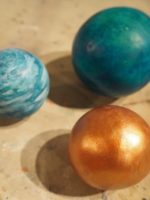
Painted Clay
A resource inspired by the Japanese art of dorondongo, where mud and dirt are shaped and buffed into highly polished spheres.
A resource inspired by the Japanese art of dorondongo, where mud and dirt are shaped and buffed into highly polished spheres.
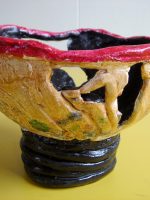
Artist educator Sharon Gale working with KS1 & KS2 students at the Weston Park Art Club shares a clay pot making resource: “This is not the traditional way of making coil pots but it’s lots of fun and by using different paint effects, the end results can be very interesting. We worked on this project for two, two hour sessions”.
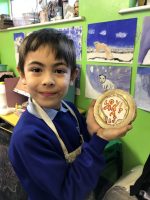
In this three stage resource, students make a circular medal from clay depicting their own profile, look at examples of fun lettering and devise a short, fun or meaningful phrase to paint inside their portrait profile.
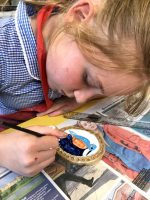
This two stage clay and painting resource by artist/educator Sharon Gale is very versatile because essentially the miniatures are blank canvasses. In this particular workshop, the subject matter had to link with KS2 Geography and the topic of rivers. Students were asked to research their favourite creature or plant, that made the British riverside its home. They made their miniatures from clay and painted their chosen wildlife onto them.
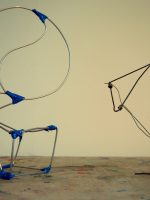
Teenagers working with Melissa Pierce Murray used thin wire to make works with a strong presence. They began by looking at examples of works by two contemporary women artists including Phyllida Barlow and Rebecca Warren.
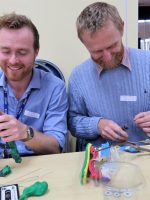
See how teachers, museum educators, the local scrap store and arts organisations were brought together for a making session inspired by Brilliant Makers at Arbury Primary School, Cambridge with year three teacher Eilis Hanson.
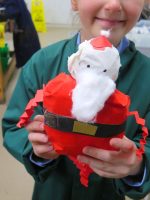
A fun end of term project that would also be perfect to do at home – making model Santas with character! Jan Miller share a process to make 3D model Santas using simple materials and processes. This activity can be used with children aged 7 to 14 (any KS, 2, 3 children).
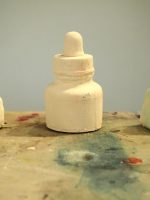
Artist Melissa Pierce Murray led a series of workshops for teenagers exploring a variety of casting techniques.
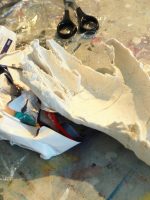
In this post, artist Melissa Pierce Murray, shows, step-by-step, how teenagers made modroc casts of their hands.
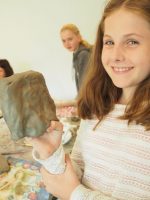
In this post, artist Melissa Pierce Murray, shows, step-by-step, how teenagers explored plaster casting by making simple clay ‘waste moulds’ and then moved on to making simple ‘two piece moulds’.
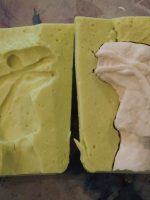
Artist Melissa Pierce Murray introduces teenagers to the process of casting with non-toxic and fast-setting alginate.
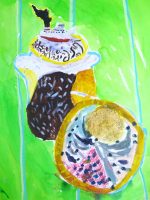
Jan Miller shares a class project that uses the work of a contemporary Japanese ceramicist to inspire vibrant paintings in a variety of materials. The children then used their own art to design ceramic vessels.
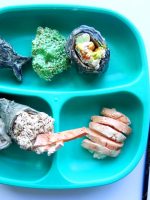
Inspired by research into Japanese culture, children explored the potential and limitations of paper and recycled materials, learning through play and experimentation to make 3D forms. The outcomes of this process were used to inform work created in a second medium of clay, using kitchen equipment to shape the clay and add textures.
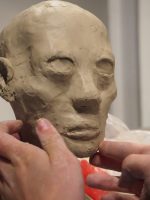
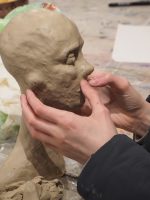
This is the final post in a series of posts following teenagers modelling a clay head over a term with artist Melissa Pierce Murray. In the final session of the series: Modelling the Head in Clay, we look at how to form the features: eyes, ears, mouth. We look at ways to finish and embellish the form using hair, clothing or inventing horns. In the class we talked about how the muscles attach to the bones, and how the skin smoothes over the surfaces.
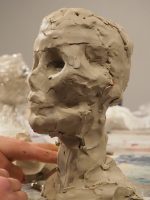
This is the third post in a series of posts we concentrated on creating a solid armature and clay foundation for our clay heads. In this post This post is the third in a series of posts following teenagers making a clay head over the course of a term with artist Melissa Pierce Murray. Here they concentrate on developing the shape of the cranium and forehead, the structure of the eye sockets, cheekbones, jaws and teeth.
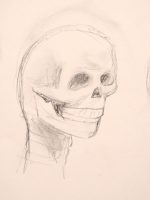
This post looks at two preparations for making a clay head: drawing to help us learn to see the form in the round, and taking measurements from life.
This is the second post in a series of resources showing how teenagers modelled a clay head over the course of a term.
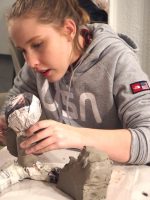
Making a Steel or Wood Armature is the first in a series of f resources showing how teenagers modelled a clay head over the course of a term.
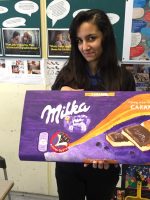
Art educator Anne-Louise Quinton shares a process for making super sized food sculptures from everyday materials, inspired by the work of Claes Oldenburg. This is a fun and challenging sculpture project for Year Nine and above.
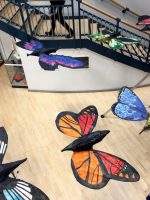
Art educator Anne-Louise Quinton shares a workshop for making a flock of large, withy butterflies, creating a colourful and dramatic artwork.