<< Back to the main #BeACreativeProducer Project pages <<
The #BeACreativeProducer Animations!
How You Might Use our Animations
Watch the Film in its Entirety (26 Minutes)
Inspiring Creativity in Teenagers…

The #BeACreativeProducer Project Aims to Inspire & Enable Teenager Creativity Through Film & Animation. Start Your #BeACreativeProducer Journey Here!
Animations to Inspire
Made by the #BeACreativeProducer team, we have over 25 minutes of film and animation to inspire your teenagers.
The animations are the result of over 9 months work by 5 young people from Cambridgeshire, with all the artwork, sound, and animation created by the teenagers themselves.
Resources to Enable
We have created a whole range of resources which share how we made our animations, so that you can make yours! Learn to make stop motion animations using characters (bought and made), green screen, flick books, photoshop editing, whiteboards, and cut out lettering.

Meet the Original #BeACreativeProducer Team
Background to the Project
The #BeACreativeProducer Project started in June 2018 when 5 teenagers (Alex, Amelia, Immy, Lluis and Rowan) led by Paula Briggs from AccessArt, began on a journey to make animations designed to inspire creativity in other teenagers.

The legacy of the project – the Final Animations, and Resources, are an inclusive way to widen the benefits of the project to audiences of young people in the UK and overseas.
The #BeACreativeProducer project encourages teenagers to work collaboratively, or alone, to create film and animations about the things they care about, and so helps young people develop their voice.
The project also helps teenagers balance their experience of the digital and physical world to feed their creativity.
Why Animation?
Exploring animation and film is an amazing way to inspire and enable teenage creativity.
The original #BeACreativeProducer Project demonstrates that an exploration of film and animation can offer teenagers a unique opportunity to develop their own creative interests, whatever they might be. Better still, by contributing those interests to a collaborative project they could then see the results valued by others.
The project encouraged teenagers to value their passions and skills, including woodwork, craft, printmaking, painting, drawing, calligraphy, drama, playing instruments, composing music (physically and digitally), and photo and film editing. All these skills have been brought together to make the final films and animations.
Teenagers can work alone or in small groups to make their animations. Whilst some teenagers will prefer to work alone and bring a variety of skills into their project, others will prefer to work collaboratively, sharing skills and inspiring each other.
Finally, making animations and films about things young people care about is the perfect way to help teenagers find and share their voice.
Who Might Enjoy Taking Part?
The #BeACreativeProducer project is suitable for ages 10 to 16.
Teachers might like to use the animations in assemblies, classrooms and after school clubs to promote discussion amongst pupils about why we should value and develop our creativity, and to inspire their own #BeACreativeProducer journey.
Workshop leaders or facilitators might also like to use the resources in galleries, museums and community centres with youth groups and workshop audiences.
Parents and home educators might like to help facilitate the #BeACreativeProducer journey with their families.

Watch our Animations
Watch All The Animations
See our Resources
See The Animation Resources
Organise a Digital Wellbeing Week
Find Out How You Can Use Our Films To Explore Digital Wellbeing
See How The Resources Are Being Used With Pupils
See how others have used the resources and be inspired…
See the Winners of our Last Call
See all Winners!
See the #BeACreativeProducer Project Show Reel
See Our Bloopers!
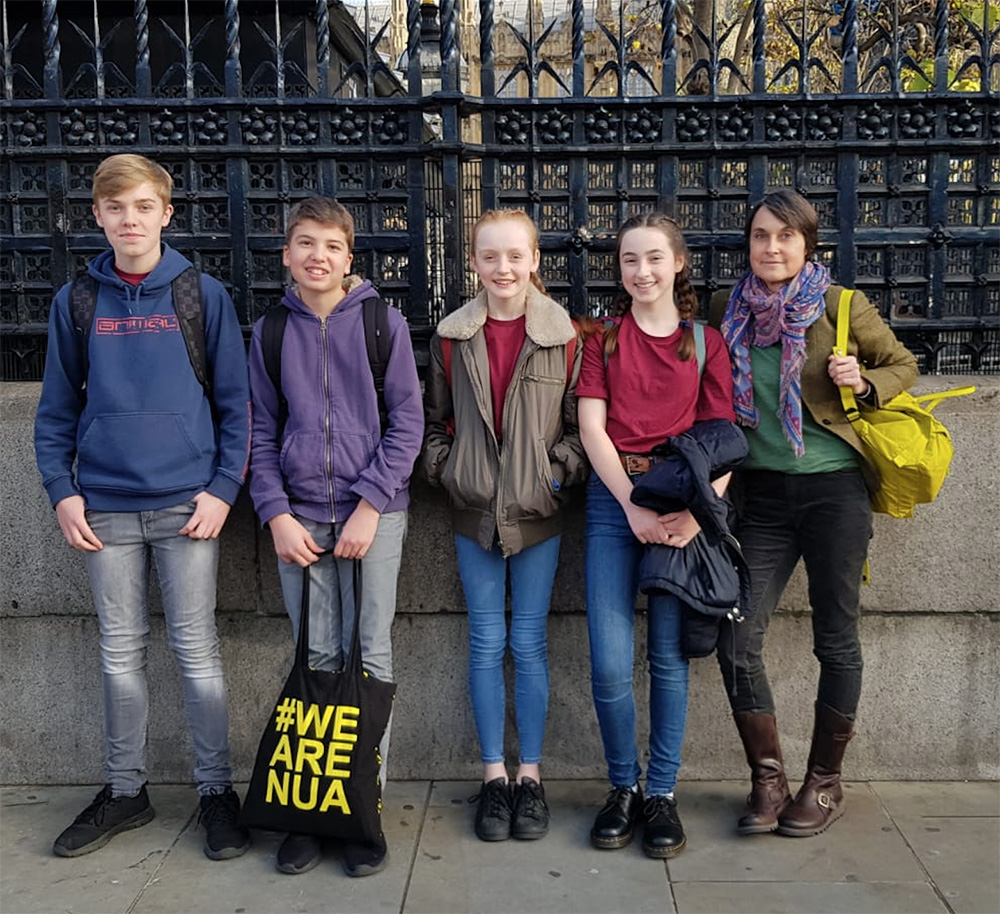
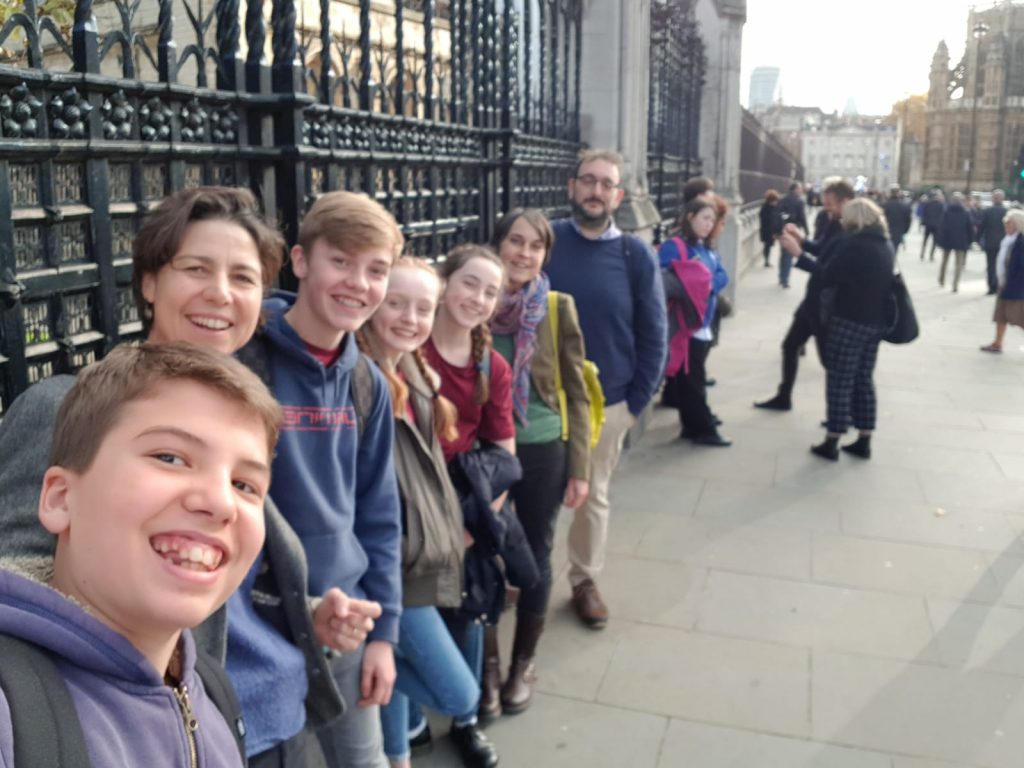
See the Original Team Present at the Houses of Parliament!
Read Their Presentation
Giving Teenagers Their Voice Through Film & Animation
“Imogen has really enjoyed being part of the team for the CP project. Although she was a creative individual before the project (participating in lots of dance classes and playing/composing classical music) Imogen has been introduced to many more creative avenues and now has a much broader view of creativity.
She particularly liked the group discussions that the team had at various stages, learning how to work as part of a small team, picking up new skills associated with stop motion animation, helping to run workshops, interviewing others and filming. Imogen is excited about the idea that the project might encourage other teenagers to become more creative in the future.
Overall her confidence has visibly improved as a result of this opportunity and she understands much more about how digital technology can be used to great effect in creative situations.”
Parent of #BeACreativeProducer teenager
“As part of the #BeACreativeProducer team Amelia has worked on an exciting animation project from initial concept all the way through to a fabulous finished product. With constant encouragement from Paula, ample opportunity to try things out, to reflect on and overcome false starts, and plenty of hard work later, Amelia is really proud of the results that the team has achieved.
An unexpected side-effect is that she has also gained great confidence in public speaking through canvassing members of the public for contributions to the project, leading workshops for (even) young(er) people and being part of the team that presented the project to the All Party Parliamentary Group for Art, Craft and Design in Education.” Parent of #BeACreativeProducer teenager
“The #BeACreativeProducer project ‘can do’ approach teaches teenagers to pick themselves up when they are down, demonstrates how collaboration and communication encourage creative thinking, provides stimulation, inspiration and constant feedback so that they never feel alone in their creative bubble.
Alex has grown in maturity and confidence as a member of the #BeACreativeProducer team. He has shown a level of commitment and tenacity beyond his years and far in excess of that we could expect a year ago; composing music for the project has given him a focus and reason for his creative exploration. He really understands that effort = output, has a real sense of pride in his work and values the importance of the team members and their network of mutual support.” Parent of #BeACreativeProducer teenager
Read, See & Hear the #BeACreativeLaunch Night
Read, See & Hear More About the #BeACreativeLaunch Night
Get in Touch
Email us at info@accessart.org.uk
Credits
Thank you all those who supported the original #BeACreativeProducer Project
The World Needs Your Creativity: Winners!
It’s been amazing to see the animations entered for the #BeACreativeProducer Animation Competition! The teenage #BeACreativeProducer team of Alex, Amelia, Immy, Lluis and Rowan can be very proud of all the creativity they have inspired!
We had a very difficult but hugely enjoyable time watching the animations and thinking carefully about how to choose the winners. We had 32 entries: the standard was very high and the outcomes very varied.
“All the entries we received were really very impressive. The ways everyone interpreted the brief were engaging and interesting but all completely unique – some of them made us laugh and others made us cry! The range of topics made them quite difficult to judge as they were all such high quality! Well done to everyone who took part for entering such incredible animations – and especially to those who won prizes and were shortlisted.” Immy, #BeACreativeProducer Team Member
In the end, after judging against our criteria (did the animation answer the brief? was it innovative? did it communicate its message?) the team decided we had to have more prize winners! Using money raised in their Crowdfunder as prize money, the teenage team very generously decided themselves to award the following prizes!
Congratulations to all who entered – its was such a hard choice and we loved receiving your work. All the entries below will be shown at the Opening Night of the #BeACreativeProducer Project at Cambridge Junction on the 28th February 2019.
Watch this space for the next competition.
Winner – Ben Heiss
The Henry’s Odyssey Prize Wins £100 Voucher
The #BeACreativeProducer team of judges loved the very clear message behind this animation which answered the brief of “The World Needs Your Creativity” so brilliantly. They also thought the music worked well with the visuals. Great story telling and great pace! Well done Ben.
The Henry’s Odyssey Prize is sponsored by Sarah Cannell in aid of Henry’s Odyssey
Second Prize – Zuzanna, Mariam, Malaikah
The Scolaquip Prize – Wins £75 Voucher
The judges thought this was a very powerful animation and very much echoed the messages behind the larger #BeACreativeProducer project. Created by 3 girls from Dixons City Academy in Bradford, the judges loved it because it was graphically very strong.
The ScolaQuip Prize is sponsored by Scola
Runner Up – Finlay
Wins £50 Voucher
This judges loved this animation by Finlay for its quirky humour and use of objects and technology as props for the animation. Thank you Finlay for making us laugh, and a great message too!
Leo, Jack, Sara, Megan & Dora
Each Entry Wins £20 Voucher
It was SO hard deciding who should win, and the following animations came very close. We decided we had to give them a special mention. Varying so much in style and outcome, please enjoy watching the four animations included in the next showreel, by Leo, Jack, Sara, and Megan & Dora…
#BeACreativeProducer Team Present at the Houses of Parliament
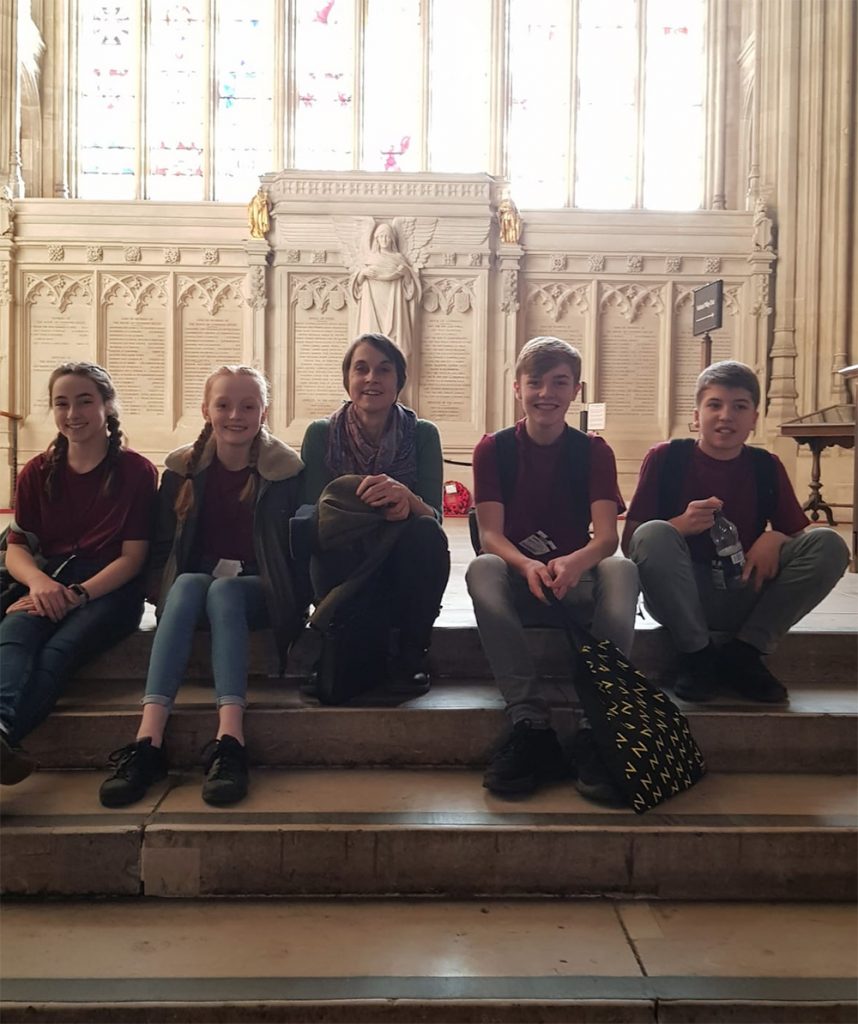
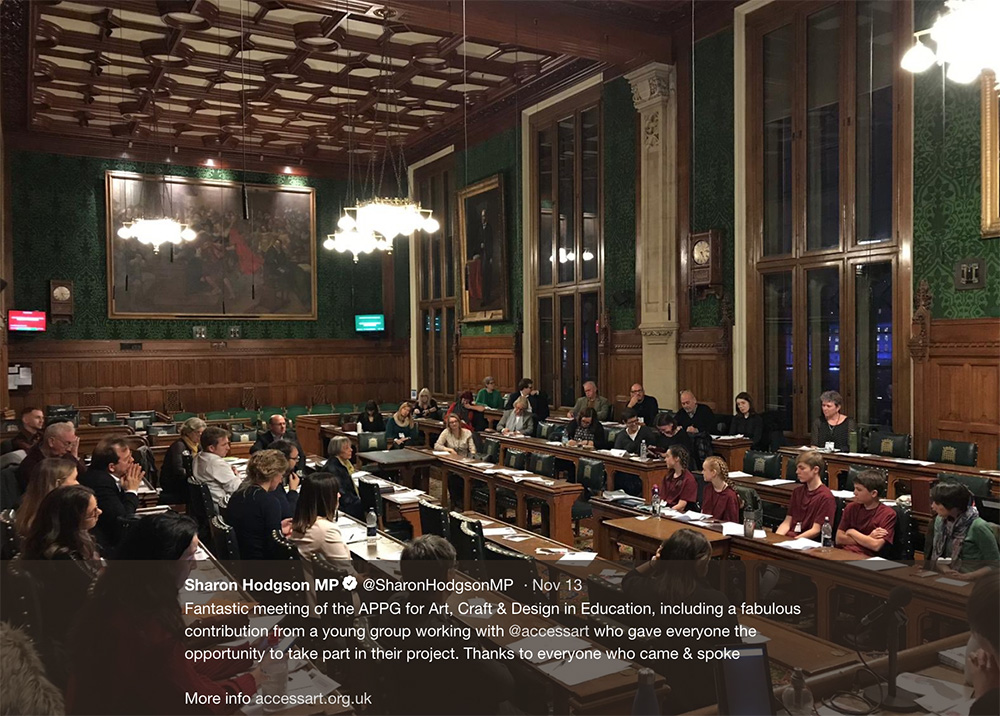
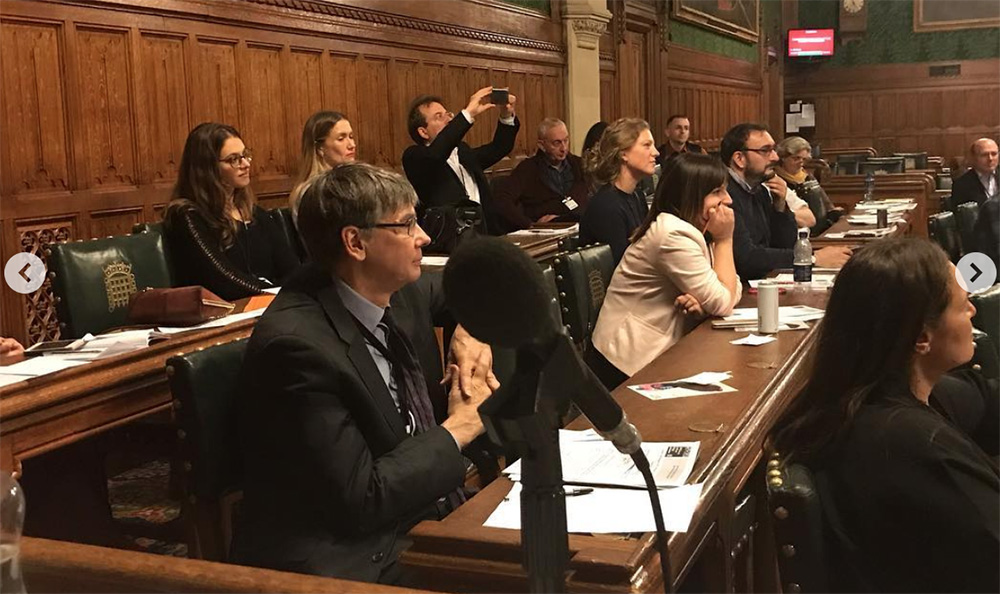
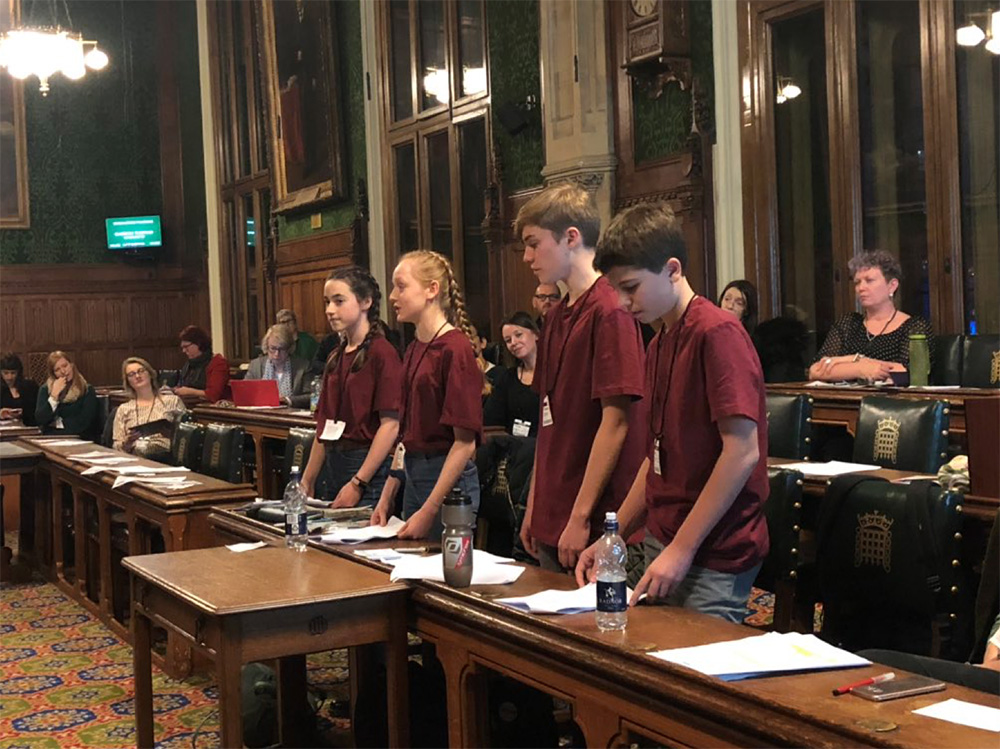
The teenage #BeACreativeProducer team were invited to present their project at the APPG for Art, Craft and Design Education at the Houses of Parliament, London, on November 13th.
A full transcript of their presentation, including video clips of their animation, are provided below.
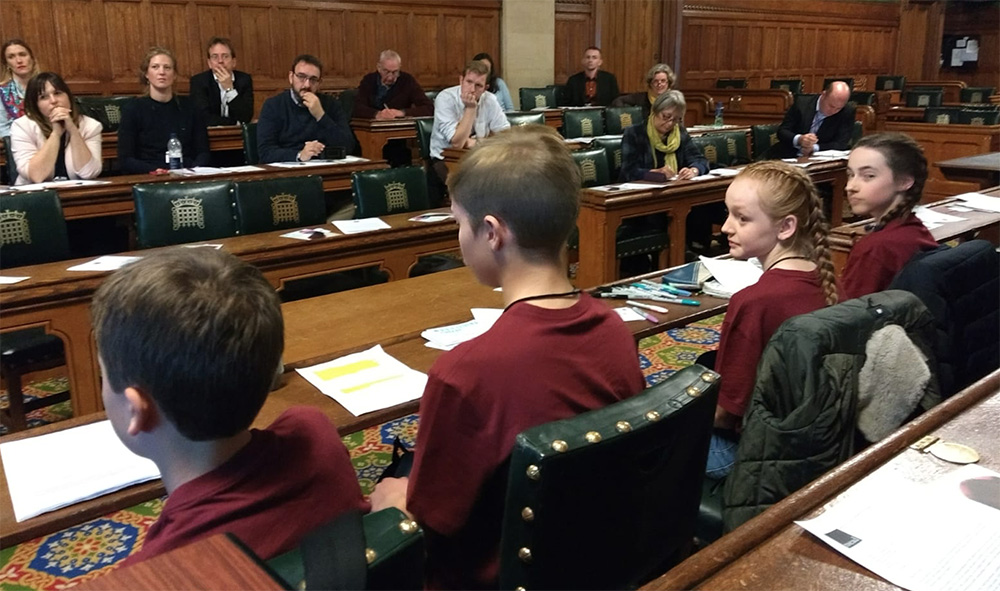
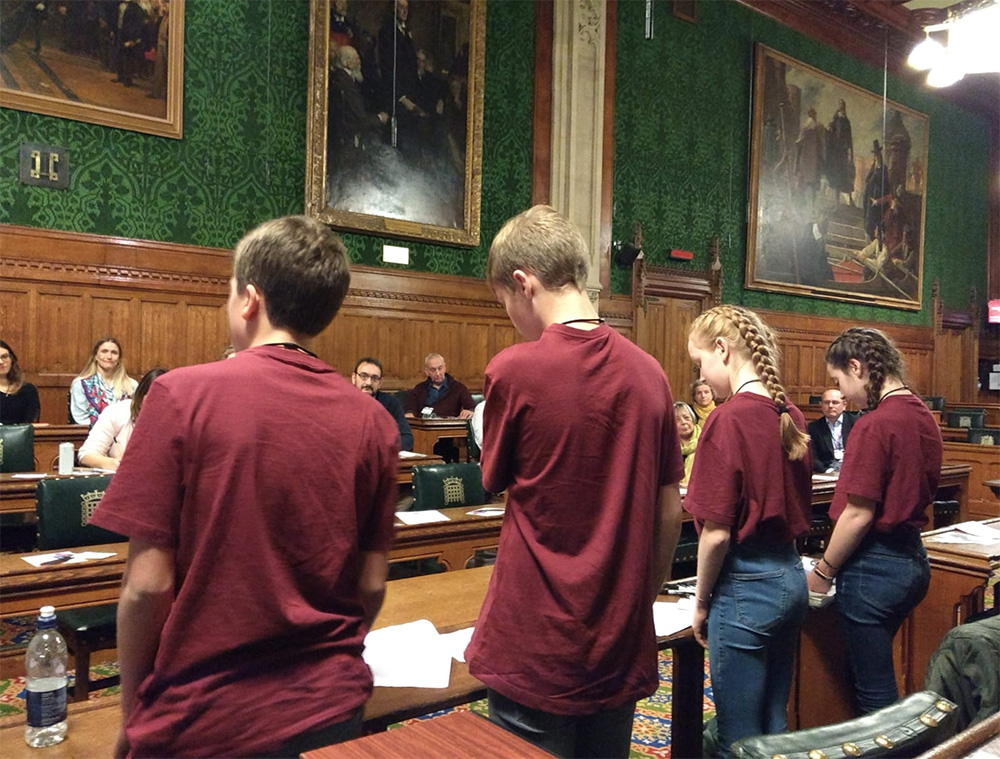
The team did incredibly well, holding the room with confidence, eloquence and creativity in abundance as they shared their experiences of the project, and spoke in support of arts education. They also answered a number of questions, holding the floor for 40 minutes. Well done team!
Find out more about the project here.
Introduction by Paula Briggs, Co-Director, AccessArt
“Hello, My Name is Paula from AccessArt, and I’m here with Sheila, my colleague, and the teenage #BeACreativeProducer team. I’m not going to talk for long before I pass you over to the team.
First of all a big thank you to the APPG for inviting us, we really appreciate the opportunity and we hope you enjoy our presentation.
I want to talk briefly about Creativity, and to look at the ways our project is enabling creativity in teenagers.
I don’t think a week goes by when Sheila and I don’t have a conversation about the nature of creativity, and the fragility of the creative process. The teenage years in particular, can be a time when a young person’s creativity feel’s especially vulnerable. I want this to be an upbeat presentation, as I’m sure it will be, and these teenagers definitely deserve that, but I do want to touch on 2 things that can undermine teenager’s creativity.
The first is the message we are giving to teenagers today, that there is a subject hierarchy, and that creativity is way down at the bottom. Let us all acknowledge, that by pushing creative subjects down in that subject hierarchy, we are in effect telling teenagers that their creativity does not matter. Not all teenagers, not all schools, many schools are managing to preserve their creative offering, but in general, this is the message teenagers are hearing.
The second thing which can undermine teenager’s creativity is social media, or to put it into a wider context, the ability of the phone to keep the teenagers’ attention.
Before I go any further I want to clarify, Sheila and I are great advocates of digital – we know that through embracing all things digital we have been able to impact upon visual arts education. BUT, we all acknowledge that social media has two sides: educational, inspiring, connecting, but it can also be distracting, and prevent a connection with the physical world. Even teenagers themselves acknowledge that whilst it can inspire them, it can also drain them.
The problem is that social media can prevent teenagers from paying attention to their creativity. It is the thing they go to when they are bored, when they have finished something, or even when they haven’t finished something, as a distraction.
So whilst on the face of it the #BeACreativeProducer project is an animation project, a project in which a group of creative teenagers come together to share their skills, to create animations which celebrate and advocate teenage creativity, the project is also about how we can address the things which put pressure on a teenagers creative potential.
Number One, we need to look teenagers in the eye and tell them we value their creativity. We need to SHOW them we value their creativity. We need to enable teenagers to look each other in the eye and support each other’s creativity, and we need to make certain that teenagers can therefore look themselves in the eye, maybe next time they take a selfie or look in the mirror, and tell themselves that their creativity is an important part of who they are.
Number Two, we need to help teenagers pay attention to their creativity. Creativity is a fragile beast, but it is also resilient. We can push it down personally (we have an idea which we dismiss), we can push it down socially (we can neglect to invest time and money) and ultimately we will push it down economically (if we have not invested in the creativity of a generation, how can we expect to reap economic rewards), BUT the creative urge will always be there, lying waiting, it is an intrinsic part of our humanity.
The good news is, if we can pay attention to even the smallest of creative urges or sparks, they will grow. We only need to tune in, and we will feed our creativity. It is the tuning in, or the showing up, that’s vital. So, whilst art lessons are filled with techniques and art history and contextual studies, I would also suggest we need to think more about how we can enable teenagers to understand what it is like being IN the creative process, with its ugliness and beauty, inspiration and frustration, moments of desperation and moments of eureka. It isn’t about the end result, though that is often great, it is about the create journey, and whilst we all go on our own journey, there are commonalities which we should be talking about more, so that we can reassure and demonstrate to teenagers that what they feel whilst they are being creative, is ok, and so enable them to continue on their journey.
We’d like to start with a quick video to introduce the team and the project. The fifth member, Immy, is at a ballet exam – we wish her good luck!”
Alex
The Project started in June. We noticed amongst our classmates that some people were pursuing their interests and hobbies, whilst others were dropping them as they weren’t seen as cool. Instead they were spending more time on their phone. The project started as a message to help teenager become aware of how much time they are spending consuming digital, and to remind them that they can be producers, as well as consumers.
Amelia
But the project quickly developed into much more than that, and the animations we are making now are about helping teenagers think about how important their creativity is, both to them and to the world, and how they can become more creative.
Alex
We’re definitely NOT saying that digital is a bad thing – the project wouldn’t exist without digital, but we are trying to remind teenagers to consume it mindfully, and to balance it with the physical world.
Lluis
We have been meeting most weeks since June, after school and at the weekend. We must have put in hundreds of hours of work. The project will finish in February 2019.
Rowan
So what are our sessions like? Varied, is probably the best way of describing them! We usually start off around the table (eating pancakes) whilst Paula brings is up to date on things that have happened during the week (like being invited to the houses of parliament). We look back at clips made the week before, think what we might need to do to change them.
Amelia
Then we usually split up into pairs to work on new animations. So, two of us might be animating letters on a whiteboard, whilst another two might be editing photos in photoshop or in iMovie. Or we might be making physical models for an animation, and filming each other or recording voice overs. Every now and then we get together to compose music collaboratively, or compose it individually at home.
All the clips are then sent back to Paula’s laptop for us then to edit together to make the scenes… Like Scene 2 which we would like to share with you now.
Rowan
We’re so proud of what we’ve achieved so far. As well as being invited here, to share the project with you, we have also led a workshop at the Arts Picture House Cambridge, and have been invited to write a blog post for their website, and screen part of the animation before a main feature in 2019. Cambridge Junction will host a launch party for the finished animation in 2019. If you’d like to come to the launch then pls let us know.
Lluis
Every session we do is documented and Paula then creates a post on the AccessArt website so that others can be inspired and have a go.
We have also run a successful crowdfunder appeal to pay for workshops for schools on the launch day, AND for prizes for an animation competition we have launched.
Alex
“The World Needs Your Creativity! Animation competition is for ages 11 to 15. We had the idea, to get other teenagers involved, by inviting them to create a 30 second animation. The winning entry will receive £100 worth of vouchers and also have their animation included in our main animation on the opening night. You can find out more about the competition on the AccessArt website.
Amelia
The final animation will be around 20 minutes long, split into 5 scenes which can be watched alone, like scene 2 you just watched. We will also have an animated quiz section to help teenagers think about their attitude to consuming and creating digital content.
Rowan
The end result will be shared via social media and the AccessArt and #BeACreativeProducer websites, and we hope that schools, arts organisations and community groups across the country will share it with teenagers to help inspire their creativity.
Alex
So, What Have we Learnt from the Project?
The Project has helped us build a variety of skills….
Amelia
It’s helped me build confidence in public speaking and helped me grow as a person. We are able to work as a team and empower each other in a relaxed and positive environment, which is an opportunity we don’t often get at school.
Alex
The project has given great encouragement to everyone’s creativity. For me in particular, it has helped feed my skill and interest in composing music, both for the project and for my own pleasure. I think my attitude to my own creativity has developed hugely throughout the project.
Rowan
I think that one of the most important things to me about the project is the way we are all able to contribute our ideas into what we do next, in a way we can’t at school. Every session we are given the opportunity to input our own thoughts and opinions, and then have the freedom to put our ideas into action.
Lluis
Working on the project has given me a reason and a focus for my woodworking. I’ve enjoyed sharing what I’ve made and seeing them valued in the project.
Amelia
We would also like to see if we can develop the #BeACreativeProducer website (if we have the energy!) into a place which encourages teenagers to make and share their own animations, either alone or as a team, about things which they care about.
Rowan
So how can you help? Pls share the project and the competition, and we hope we have inspired you to look teenagers in the eye whenever you can and tell them that the world needs (and values) their creativity!!!
If anyone has any questions, we would love to answer them.
Thank you.
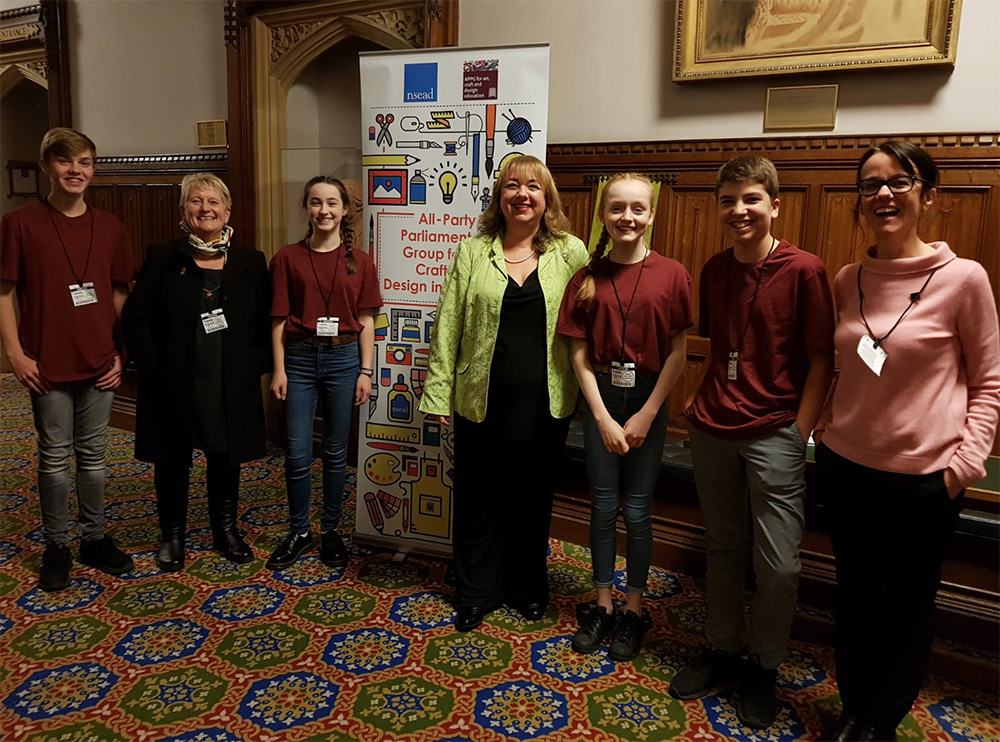
The Team invited the audience to write messages in support of art education on mini-banners. The banners were then animated back in Cambridge, and a sound track made…
https://vimeo.com/301462578


Very many thanks to the Board of the APPG for Art, Design and Craft Education for inviting the team to present.
AccessArt Exemplar Primary Art Plan + Progression Plan
PLEASE NOTE
AccessArt has created a new Primary Art Curriculum which you can find here.
Schools will continue to have access to our old Exemplar and Progression Plan (below) but we urge new schools to follow the new curriculum available here.
AccessArt has created 3 plans to help Primary schools deliver a rich, exciting and relevant art education.
1) The EYFS Exemplar Curriculum Plan
2) The Primary Art Curriculum Plan
3) The AccessArt Progression Plan
The AccessArt EYFS & Primary Exemplar Plans
-
What Are the Aims of the Exemplar Currciulum Plans?
-
To provide schools with a rounded art curriculum for ages 5 to 11 (Primary) and help in establishing an open approach to creativity for the under 5s (EYFS).
-
To provide NQTs, art coordinators and all primary teachers with the skills and resources to deliver an engaging, relevant curriculum.
-
To suggest visual arts educational activities which will promote open-ended, creative learning.
-
To provide ideas, inspiration and techniques to enable children to explore a wide variety of media in drawing, sketchbooks, sculpture, painting, printmaking, and design.
-
-
Using & Developing the Plan in Your School
The exemplar plan is a suggested way forward. If a school were to follow the plan (based upon tried and tested teaching), by the end of Year Six the pupils would have received an exceptional and rounded creative education. However we appreciate each school, class and pupil has individual needs, and that many teachers and schools will prefer to use this plan as a starting point to be adapted. We value this evolution: please do get in touch to share your successes!
Find out how to scaffold the projects in the plan with sketchbooks and drawing, to ensure even richer journeys and outcomes.
-
How it Works
-
Click on the Year buttons within the plan to see the exemplar plan for each year.
-
Each year is split into 6 projects, one for each half term. Click on the suggested resources within each plan and you will be taken to fully illustrated resources which describe the aims, techniques and and outcomes of that particular activity.
-
Within each year, we have tried to balance development of skills in the main artform areas and with a variety of media.
-
The plan for each year builds upon previous skills learnt. However, the plan and the suggested activities within each year are transferable and adaptable. For example, you are able to switch activities within a school year, or even between school years, to suit your broader curriculum and the needs of your pupils.
-
-
Accessing the Resources
-
Whilst many of the resources are free to access, you will need to be a member to access the majority of our resources.
-
AccessArt is a UK charity (1105049) which aims to inspire and enable high quality visual arts teaching and learning. We receive no core or revenue funding, instead we rely on income from membership to continue to develop our activities. AccessArt has over 18000 members and is trusted by schools across the country to help develop their teaching and learning.
-
Membership (and access to all resources), starts at just £42 per year.
-
-
Further Information about the Curriculum
Please see this page here for a detailed breakdown of AccessArt’s approach to the currciulum for KS1 and 2.
Download The AccessArt EYFS Exemplar Plan

Download the Powerpoint Version
Download the PDF Version
Download The AccessArt Primary Exemplar Plan

Download the PDF Version
AccessArt Members Only:
Download an Editable Powerpoint Version of the AccessArt Progression Plan
Please note, AccessArt members can download the PPT version of our AccessArt Progression Plans so that you can edit the documents to suit your school’s needs. However please be aware that we regularly update our documents in response to changing requirements, and to developing resources on our site, so you will want to check in each year with the master version to check for relevant recommended changes.
The AccessArt Progression Plan
Please Note: There is a new version of the Progression Plan here.
-
What Are the Aims of the AccessArt Progression Plan
The AccessArt Progression Plan attempts to balance a number of important elements in art education. Create opportunities for new experiences balanced with:
- Time for repeated practice.
- Structured learning, balanced with.
- Space for personal exploration.
- The accumulation of technical skills and contextual knowledge, balanced with growing self-awareness of what it is to be a creative being.
Through all of the above, our aim is to enable individual pupils to make appropriate choices regarding materials and processes and to be empowered towards making a personal, creative response.
The plan is based upon a creative and holistic approach, which shows the inter-relations between various aspects of the visual arts, demonstrating how subject knowledge, skill and progression is built when all the elements work together.
We acknowledge the importance of teaching specific skills, sensitively modelling some materials, and introducing a wide variety of materials, concepts and artists as soon as possible.
We also advocate the importance of pupils being enabled to follow their own creative pathway, and the progression plan shows how this might best be encouraged to happen. When to let a child go, (and we would always argue that that should be as as soon as possible) and how to enable that exploration, is key to a successful art education.
The progression plan attempts to balance two very important elements of a high quality visual arts education: 1) practice with 2) novelty. The plan demonstrates how opportunities can be created for repeated practice and consolidation of skills, alongside opportunities to introduce new materials and concepts to feed and excite the creative process.
We are keenly aware that many of teachers in primary schools are not specialist art teachers, and in many cases they did not have a comprehensive art education themselves. The progression plan links to example AccessArt resources to help non-specialist teachers understand how best to facilitate art.
Finally our progression plan was written from a slightly different perspective than many. It is less about measuring the progress of pupils, but instead it attempts to pinpoint the stages of opportunity which should be presented by teachers. If the appropriate opportunities are created, then pupils will progress.
-
Assessment
There are no national standards set in art for primary-aged children.
AccessArt advocates for conversation-based assessment in art which takes place on an ongoing basis. The conversations might take place as a class, as a group, or one to one and will feed into processes of reflection and evaluation. These are not activities which should just take place at the end of projects, but throughout the creative process. This makes assessment meaningful, and not a tick-list process which bears no use or relevance to the child.
This kind of assessment requires that the teacher is actively involved in each learning journey of every child, which we understand is potentially time consuming. We believe this type of assessment underpins good teaching and leads to better outcomes, especially in such a sensitive area as nurturing a child’s creativity.
Explore a resource of facilitating a gently and reflective class crit.
-
Vocabulary
We will be producing a full guide to progression in vocabulary in 2021, including a glossary, but in the meantime key words, ideas and phrases are highlighted in pink on the Progression Plan
-
What is our Approach Based Upon
AccessArt is the specialist provider of visual arts educational resources in the UK. We have over 20 years experience of facilitating the visual arts in schools.
Our progression plan is based upon the expertise within the AccessArt team.
The plan takes into account current National Curriculum guidelines, and bases its end of year descriptors on those supplied by the NSEAD curriculum.
We would also like to thank Susan Coles, Paul Carney and Mandy Barrett for their generosity in sharing their ideas and approaches in relation to progression and assessment with the primary field.
We would like to take the opportunity to thank all those working in the field, and acknowledge that the skills and experience of all those in the field build upon and benefit from an open and ongoing conversation.
-
Disclaimer
We believe the curriculum we present via our Exemplar Plans, and our working methods shared via our Progression Plan, provide schools with a way to access a rich art education for pupils, of which schools can be proud.
The curriculum AccessArt shares is based upon our ethos which has developed over many years and which we believe has creative integrity. In the creation of the Progression Plan we have taken the opportunity to present schools with what we believe will be the best possible art education for their pupils, building and enhancing upon what already exists.
Schools should note that the majority of our resources are created by artist-educators. Some but by no means all were created in formal education settings. It is up to teachers to assess on an individual or school community basis if the resources are right for your school, and how they might best be adapted to suit your needs.
All resources cited in both the Exemplar Plans and the Progression Plan are examples only, and there are many more resources in the evolving AccessArt database which may suit your needs better.
AccessArt presents our work to schools in good faith, but we cannot guarantee and are not responsible for the way the approach is received.
Explore the new AccessArt Primary Art Curriculum.
download The AccessArt Progression Plan
Download the PDF Version
download The AccessArt Progression Plan for MAKING
Download the PDF Version
Access the Web Browser Version of the Exemplar Plan
Click on the Year Groups below
Year One
Ages 5 to 6
Year Two
Ages 6 to 7
Year Three
Ages 7 to 8
Year Four
Ages 8 to 9
Year Five
Ages 9 to 10
Year Six
Ages 10 to 11
Join AccessArt!
Join thousands of other schools and teachers who use AccessArt to deliver great art teaching
From just £42 per year, schools gain access to over 1500 unique resources to help develop your teaching, themed visual arts planning pages and discount on our distance learning courses. AccessArt was founded in 1999 and has grown through collaboration with a variety of schools, arts organisations, agencies, museums, galleries and individuals. The Exemplar Curriculum is free to access and share. To benefit from all the resources embedded in the plan, join AccessArt from only £3.50 per month.
Opportunity to Join AccessArt: Membership & General Administrator Role
The deadline for applications has now passed.
To help us serve our growing membership, AccessArt is ready to welcome a new person to join our friendly team!
Role:
Membership & General Administrator: to help us process memberships and build relationships with schools, and to process Zoom CPD admin.
Hours:
The role is offered on a permanent basis (after a 3 month probationary period) working 21 hours per week. Hours should be worked during office hours (9.00 – 5.00) and be spread over 4 days. You need to be based in the UK. The role is fully remote.
Salary:
£16 per hour (equivalent to £31,200.00 per year working full time).
Timeline
-
Deadline for Receipt of Applications: Tuesday 26th March 2024 (Closed)
-
1st Round Interviews (via Zoom): 9th April
-
2nd Round Interviews (via Zoom): 19th April
-
Role Begins: May 2024
Job Pack
Pls find full details of role and how to apply here.
This role requires specific skills and experience. Please do only apply for this role if you feel you have the skills and experience we are looking for.
Pls note that as we expect a great deal of interest in the role we are not able to reply to personal questions via email – instead we encourage you to read the document above for all details.
Monday 4th March 2024
Job Pack
Pls find full details of role and how to apply here.
#BeACreativeProducer Launch!
The #BeACreativeProducer Project was launched at Cambridge Junction.
Congratulations to Immy, Amelia, Rowan, Alex and Lluis for an inspirational launch night, led by Paula Briggs from AccessArt. Find out more about how #BeACreativeProducer.
Enjoy the images and videos below!
Setting Up
The launch of the #BeACreativeProducer Project consisted of props made by the teenagers throughout the project, over 26 minutes of final animations and a workshop with 30 Year 6 Pupils from a local school. We spent the morning setting up, working alongside technicians from Cambridge Junction.


Exhibiting the Props
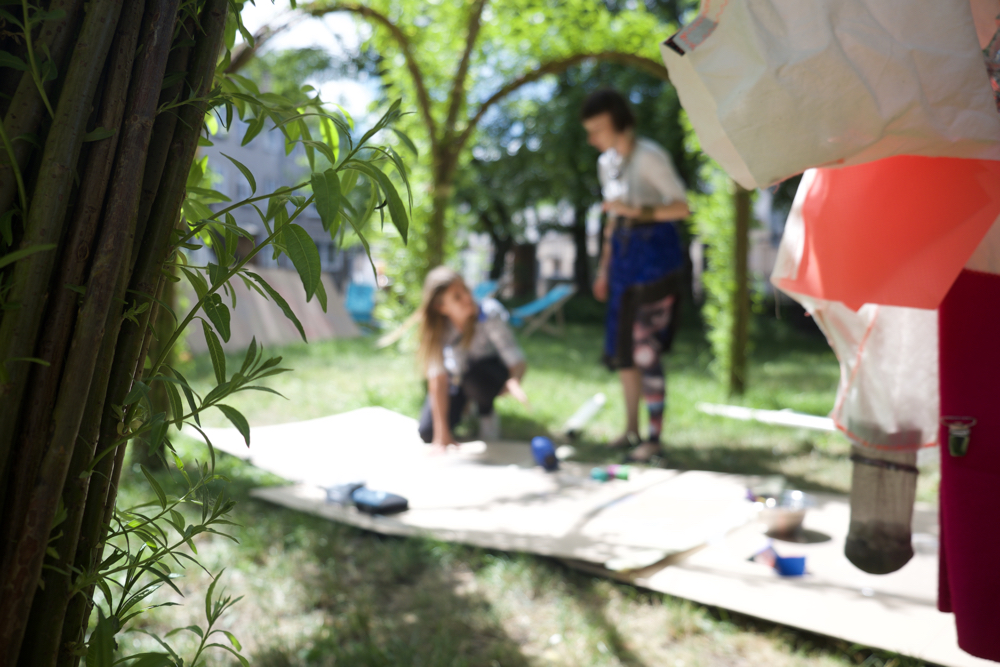
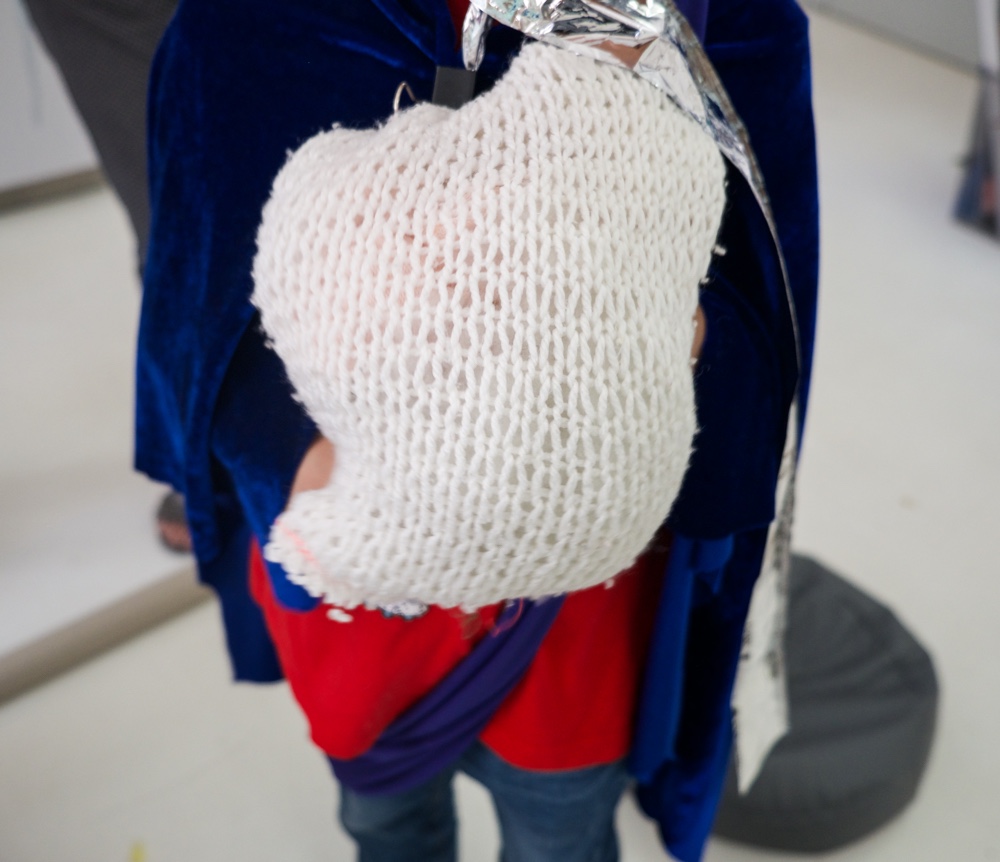
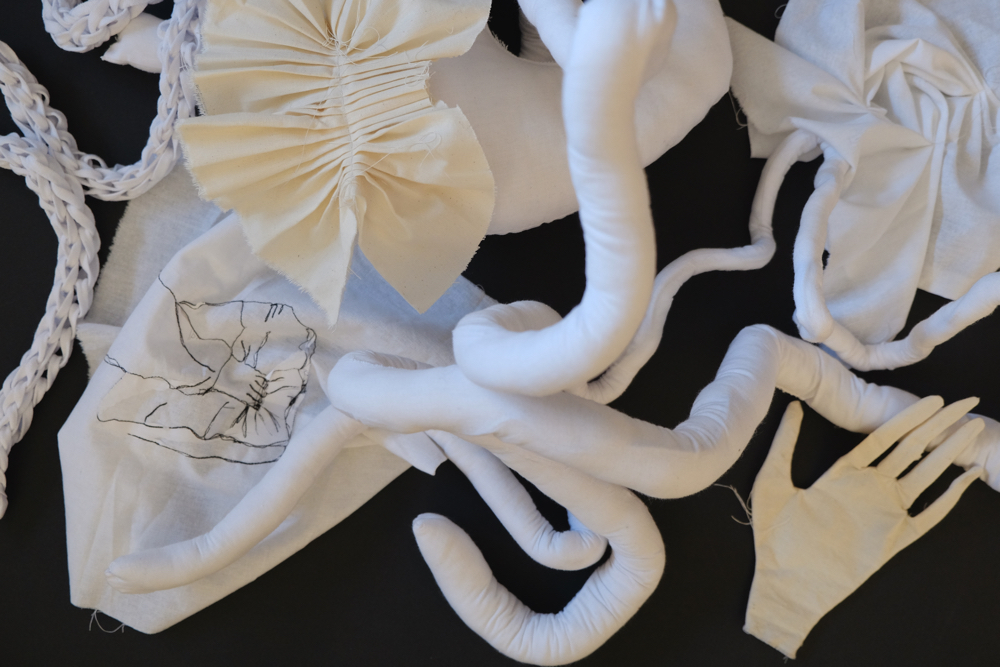
Some of the props we made as part of the animations were exhibited alongside the film and animation…


Workshop with Year 6 Pupils
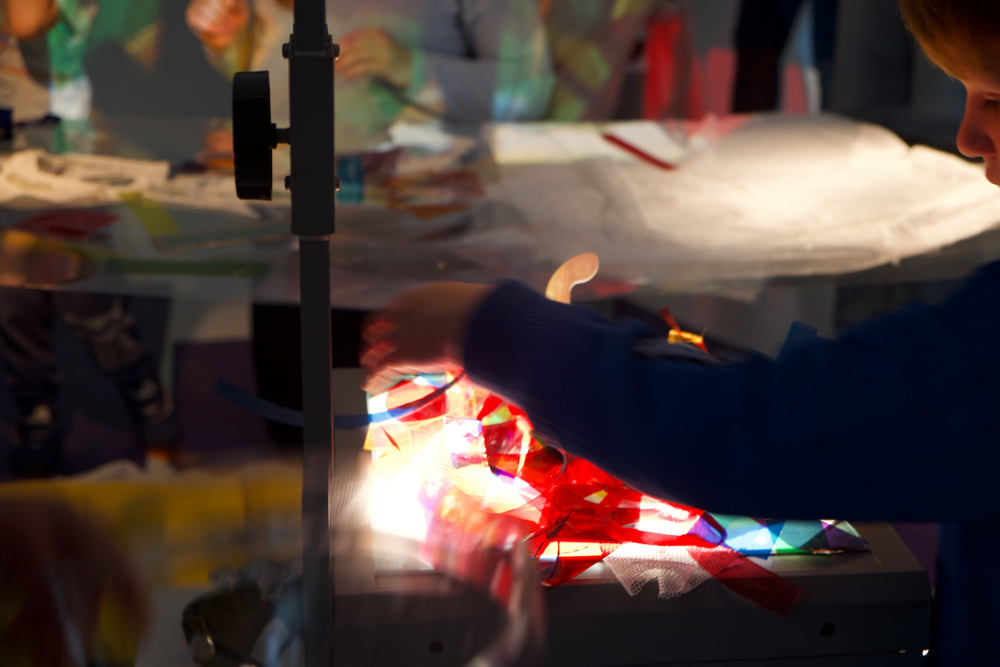
We invited a local primary school, Morley Memorial, to visit and see some of the animations and have a go at making animations.

Live Link to the Baltic, Newcastle
The teenagers had a live link with teachers from primary and secondary schools attending a teacher meeting at the Baltic Arts Centre. They showed the props, answered questions and talked about art education.

Time to Share the Final Animations!
The project was introduced by Paula from AccessArt…


and then it was time to share…

“I thoroughly enjoyed seeing the fruits of these young people’s labours last night – their creativity and confidence as 13 year-olds is absolutely awesome ! Well done for making it such a great project, and a super occasion.” Chris Owen, Honorary Visiting Senior Fellow, Cambridge School of Art

“A great event last night, you should be proud of what you started and how it developed into the final spectacular finish. The yellow T-shirt’s were obviously so engaged with the project and totally behind what creativity can bring to their lives and hopefully that will inspire others to do the same.” Jane Reynard, Scolaquip

“A totally inspiring event from @accessart #BeACreativeProducer last night. Amazing young people, and looking forward to hopefully collaborating in the future.” Lynne Simpkin, NUA

“The pupils were awesome and so inspiring. All our art teachers were talking about it afterwards. They did u proud!” Paul Carney, Neaten

“What an event this was. It shared processes as well as outcomes, it showed creativity by the bucketload, it shared the strength and power of friendship and collaboration. It made my heart sing. Can’t thank you enough for the opportunity to watch this project develop and then to attend this unique and special day.” Susan Coles, Artist, Activist & Educator
Watch the Final #BeACreativeProducer Film
Or See The Animations Split Into Shorter Scenes Here
Quiz Question Clips!
This page is a page holder for the question numbers the teenagers are working on as part of the How To Be A Creative Producer project. Find out more about the project and how the animations are being created here.
Question 1
Question 2
Question 3
Question 4
Question 5
Question 6
Question 7
Question 8
Question 9
Question 10
Question 12
Question 13
Question 15
Question 16
Teenagers Visit Norwich University of the Arts
Many thanks to Lynne Simpkin and Sam Webber from Norwich University of the Arts for making the teenagers from the “How to Be a Creative Producer” animation project so welcome when we visited the degree show.
The teenagers were given a tour of the animation, architecture, photography, fine art, games art and design, VFX, illustration, and graphic communication shows, seeing at first hand the ethos of the “How to Be a Creative Producer” project at work.
The teenagers also interviewed undergraduates to create video clips which will be used in the project. The clips will be integrated into the animation they teenagers are making.
Ways to Join In!
Take two minutes out of your day to inspire the next generation of creatives! Find out how you can submit your voice here.
Follow the project on Instagram: accessartorguk #TeenageCreativity #HowToBeACreativeProducer
Sign up below to receive be updated as the How to Be a Creative Producer project progresses. AccessArt promises not to share your information with anyone else and you can unsubscribe at any time!
[si-contact-form form=’35’]
Helping Teenagers Become Creative Producers
5 Year 9 teenagers from a Cambridgeshire school are currently working with Paula Briggs from AccessArt to create a series of animations aimed at encouraging teenagers across the country to become more aware of how they consume the digital world, and how they can take the first steps to becoming creative contributors.
Opening Night of the #BeACreativeProducer Project!
Don’t miss this opportunity to meet the teenagers, see the props made and enjoy the final animations!
learn more about the #BeACreativeProducer Project?
-
What is the #BeACreativeProducer Project?
The #BeACreativeProducer Project is the culmination of 9 months of hard work by 5 teenagers and Paula Briggs from AccessArt.
The team have been meeting after school and at weekends to share their creative skills in the digital and physical world (including art, drama, dance, music and making), to create a series of animations and films which aim to inspire other young people to value their own creativity.
The journey the teenage team has been on has been quite extraordinary and is testimony to their openness to explore the many opportunities presented to them. In addition to their hard work in making the animations, which involved a wide variety of skills from concept and brainstorming, making models, playing and composing music, filming, drama, creating artwork and models, recording voice overs, editing and marketing, the team have also visited art schools and interviewed creative adults, run a successful crowdfunder, run workshops for children, organised an animation competition, written articles and posts, and presented their project at the Houses of Parliament!
The end result, a series of animation designed to inspire teenage creativity in others, will be launched at the end of February 2019. Watch this space to find out more, and make sure you are registered with AccessArt to be kept in touch!
-
How can Schools, Community Groups & Galleries use the Project?
The final animations will be approximately 20 minutes long, and will be split into smaller scenes which can be watched alone or as a series.
The aim of the animations is to inspire other teenagers and young people to recognise the importance of their own creativity, whatever that might be. The project also hopes to encourage other teenagers to combine their creative skills, and make and share their own animations about things they care about.
The project also encourages teenagers to try to strike a balance between the physical and digital world, and to realise they can use the digital world as a key creative tool.
In particular the animations will be suitable for Year 6 (11 year old) children and upwards. The animations will be perfect for sharing in assemblies to stimulate discussion, and in art lessons and art workshops. Access to the animations is free of charge.
We hope the #BeACreativeProducer hashtag becomes used by projects all over the country (and overseas), and that we inspire other teenagers to find their creative voice.
-
When do the Final Animations go Live?
The final animations will go live on the 28th February 2019. Pls make sure you are registered with AccessArt to be kept up to date.
Introduction
Background to the Project
Teenagers present at the Houses of Parliament
See the presentation and photos
Ideas and Inspiration
Learn to animate and be enabled!
Teenagers Visit NUA
The animation team visited NUA to interview graduates and find inspiration for their project
Drama Session exploring Teamwork, Cooperation, Movement & Narrative
Teenagers worked with Pete Sayer from GruffDog Theatre on exercises to give them food for thought for their animations
Collaborative Design: Making Dungarees
Sewing and Painting and Non Verbal Communication
The Making of: The “Fill Your Funnel” Scene
We Only Have So Much Time Each Day…
Exploring Midi Art
By #BeACreativeProducer team member Alex
Simple Making Animation
Animating Building Blocks
Animating Photoshop Images
Animating with Digital Images!
The Making of: Every One Else Is Better Than Me
Giving vegetables their voice!
Animating with a Green Screen
Teenagers explore animating with a green screen to create clips
Screen Printing T Shirts
To Build A Sense of “Team” for the How To Be A Creative Producer Project
The Making Of: The Shower Scene
Teenagers make models for, and animate, the Shower Scene
The Making Of: Comebacks to the Ogres & Universal Laws of Creativity
Teenagers hit the streets of Cambridge to film the public
Quiz Clips Questions
Sneak Peek (early stage)
Animation Software
The team share their favourite software for making animations
Sewn Character
Meet Bob – a character we animated against green screen
Animating a Demonstration!
Green Screen, Mini Banners and a Great Sound Track
Launch Night!
The Finished Animations will be Launched at Cambridge Junction on the 28th February 2018!
The day and evening event will include workshops for schools and a celebratory party!
Ten Minutes, Five Times a Week

Ten Minutes, Five Times a Week is a simple set of drawing exercises designed to get people drawing. The resources are aimed at a broad audience, but designed particularly with educators in mind.
Each exercise is designed to give non-specialist educators the confidence to approach drawing, by committing to regular, brief drawing activities for just one week.
Find a 45-minute session recording demonstrating the exercises and approaches you’ll find on the page below.
WHAT ARE THE BENEFITS AND HOW DO WE FIT THE EXERCISES INTO THE DAY?
-
Who can I use the exercises with?
The exercises are adaptable and suitable to learners in all settings, including EYFS, Primary and Secondary Schools, Health & Community Care, Home Education, Lifelong Learning and Museum and Gallery Education.
-
What might the benefits be?
Our experience has shown the following benefits from similar projects:
-
Opening minds as to what a drawing activity can be as both an activity and an outcome
-
.
-
Improved dexterity (which also helps with handwriting).
-
Helps learners transition between parts of the day.
-
Improved concentration.
-
Improved sense of wellbeing through the mindful element to the exercises.
-
Improved drawing skills and improved creative confidence.
-
Improved confidence amongst non-specialist educators teaching art.
-
-
How might you fit the exercises into the day?
Ten Minutes, Five Times a Week would make a great activity to start any session in your educational setting. Try swapping your usual morning activity with this challenge, and see how it impacts the week. You could also use the exercises immediately before any other art session as a way of helping learners transition and tap into their creativity.
It’s worth noting that it doesn’t need to be a one-off venture: you can repeat the exercises as often as you want, as repetition provides an opportunity for learners to gain meaningful drawing skills over time.
The exercises are adaptable and suitable to learners in all settings, including EYFS, Primary and Secondary Schools, Health & Community Care, Home Education, Lifelong Learning and Museum and Gallery Education.
Our experience has shown the following benefits from similar projects:
-
Opening minds as to what a drawing activity can be as both an activity and an outcome
-
.
-
Improved dexterity (which also helps with handwriting).
-
Helps learners transition between parts of the day.
-
Improved concentration.
-
Improved sense of wellbeing through the mindful element to the exercises.
-
Improved drawing skills and improved creative confidence.
-
Improved confidence amongst non-specialist educators teaching art.
Ten Minutes, Five Times a Week would make a great activity to start any session in your educational setting. Try swapping your usual morning activity with this challenge, and see how it impacts the week. You could also use the exercises immediately before any other art session as a way of helping learners transition and tap into their creativity.
It’s worth noting that it doesn’t need to be a one-off venture: you can repeat the exercises as often as you want, as repetition provides an opportunity for learners to gain meaningful drawing skills over time.
Before you start…
Before Each Session: Set Expectations
The following exercises work best if the learners work quietly and with concentration. A quiet atmosphere will help learners tune into close seeing and set a calm and mindful intention for the session.
After Each Session: Reflect
At the end of each session, it’s worth investing two minutes in getting learners to walk around the room to look at each other’s work. This will help them focus and reflect on their experiences and the experiences of others. Reflection also gives learners space to recognise the value of the work that has been made. Learners might comment on what they like about their peer’s work.
At the End of the Week: Revisit
Please make time to revisit the exercises to allow learners to articulate and reflect upon their progress over the week. You may like to ask some questions…
-
What was their favourite exercise to do?
-
Which outcome do they feel was the most successful and why?
-
Is there something they would like to try next, for example, a new material?
You might like to give them a chance to repeat an exercise to allow them to consolidate their experiences and reflections.
The Five Drawing exercises…
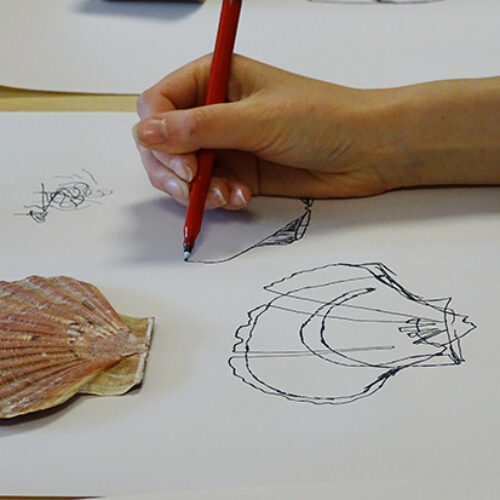
Day 1. Continuous Line Drawing
Find out how to do a simple continuous line drawing exercise to start the week.
Day 2. Backwards Forwards Drawing
The backwards forwards drawing exercise helps develop looking and sketching skills.
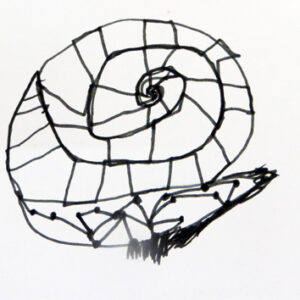
Day 3. See 3 Shapes
Explore how to get children to describe an object in just three lines or shapes.
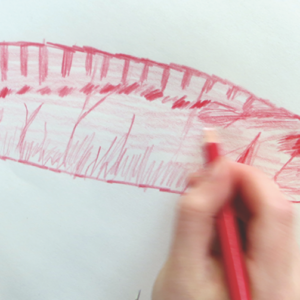
Day 4. Thoughtful Mark Making
Find out how encouraging diverse mark making will improve drawing outcomes.
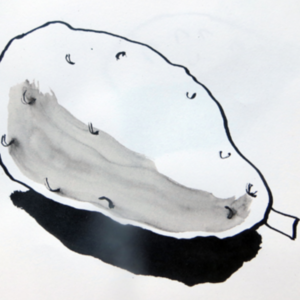
Day 5. Making Stronger Drawings
Explore how drawing on different surfaces helps encourage stronger mark making.
Why we Need to Teach Drawing in School
If you are new to teaching drawing in schools, please don’t think for a moment that drawing is a nice activity but one which serves little purpose in the real world.
The following film was made by The Big Draw
Straight from the horses mouth, the awards body OCR stresses why we need to encourage pupils to study creative subjects:
- The arts make self starters and develop emotional intelligence
All require the student to set their own agenda from within themselves, rather than follow set topics as in other subjects. They have to make independent decisions all the way, and be self-critical. They also need to be brave in exposing their creations, and accept criticism. Working in teams makes students into good communicators. - The arts stretch…
Music, art and drama require long hours of hard work and dedication. Students have to pay great attention to detail, to perfect and redo. Putting on a play, exhibition or concert takes strong organisational skills. - Arts students are highly sought-after by employers
Many employers now actively seek those who have studied the arts. Steve Jobs, founder of Apple, was fond of saying his success was due to his hiring artists and musicians fascinated by technology rather than computer geeks. Top talent management agency, The Curve Group specialising in financial and business services, concurs: “Employees with an arts degree have developed more quickly in their roles from the start. They have discipline, confidence and can accept criticism.” - Arts ‘reach the parts other subjects can’t reach’
The arts develop the broader dimensions of the human being – mind, body and soul. The arts can express the inexpressible and make sense of things that otherwise do not seem to. This can be very fulfilling and helps us function as human beings – which can only be good for society as a whole. - Arts ‘reach the students other subjects can’t reach’
Teachers find arts subjects particularly beneficial for two groups: those who struggle with traditional subjects and those who are high achieving. Less academic students can become defeatist if they feel they can’t achieve: drama, music or art can be the place they blossom. With studious students, the arts can bring them out of themselves and be a release.
Watch how learning about art and design can lead to work in this inspirational video by Creative Journey UK:
And finally, pls listen to Bob and Roberta Smith in this film by The Big Draw, explaining why we teach art in schools:
We Need To Make More Banners!

Come on!
Let’s put our passion in the visual arts , and belief in the importance of arts education, to good use. Let’s make more banners to get our message across!
The Suffragettes did it, and Trade Union Associations still do it. Bob and Roberta Smith is great at it.
Banners can be eloquent, beautiful and powerful.
They can help build community and challenge preconceptions.
Think carefully:
What would your banner say, and how would you say it?
Send us your images of banners you have made #makemorebanners
Commissioning Opportunities for Teachers & Artist/Educators
One of AccessArt’s most unique features is our evolving collection of visual arts resources which help inspire teaching, learning and practice. We now have over 1500 resources aimed at all ages and abilities and covering all areas of the visual arts.
We are continually building our collection of resources: if you are a full member of AccessArt we’d love you to contribute!
The Benefits of Contributing
- Raise the profile of your teaching/school
- Raise cash for art materials for your school, or earn money for yourself
- Add value to your teaching and give a lasting legacy to your project
- Work to the greater good!
We pay £42 per resource. Download our Guidance for Contributors for more information.
Who can Apply?
To apply for any of the commissions below you must:
- Be a Full Member of AccessArt
- Be a teacher or artist/educator
You can also Suggest a Resource here.
AccessArt Announces Partnership with Scola!
AccessArt is pleased to announce partnership with Scola. Based in Cheshire, Scola is a privately owned company formed in 1920. They sell the biggest range of UK manufactured paints, crayons, modelling materials and adhesives in the UK.
For many years AccessArt has been working to promote the importance of visual arts education. Through the creation of inspirational resources to enable creativity. AccessArt has helped inspire many hundreds of thousands of pupils, teachers, parents and artists.
We look forward to working with Scola to produce even more resources to help inspire the next generation of creative people!
Jan Miller: Our “Talented Art Teacher” Winner!
In 2016 AccessArt launched the Children’s Art Competition, supported by Cass Art. Amongst the categories for children we had one for teachers, to acknowledge all the hard work and dedication we know you put in to inspiring and enabling children.
Thank you to all the teachers who entered – you filled us full of enthusiasm and passion!
We’re very pleased to announce the winner: Jan Miller from Moreton Hall School in Oswestry. Congratulations Jan!
Jan impressed us with the sheer energy and range of her work with the children – we’re sure the snapshot of images below will give you a flavour of the work she submitted. We hope Jan will be collaborating with AccessArt very soon to create some resources for us, so watch this space!
Jan Miller – Talented Teacher Award
“I completed my degree in Illustration at Kingston University followed by a PGCE at UCL. I have almost 20 years experience of teaching Art, across the full primary and secondary age spectrum. My interests particularly lie in the students’ development of observational drawing and mixed media. I strongly believe in the use of personal sketchbooks at all levels. I expect the older students to have the same confidence and spontaneity as their younger counterparts. Similarly, I encourage the younger pupils to develop large work, over several sessions, alongside the older students. For several years I have been the Art Editor for SATIPS, a prep school magazine, to inspire Art teachers nationwide. I have recently developed Able, Gifted and Talented sessions for my own students and have extended this to a biannual event to other schools.”
AccessArt at the Houses of Parliament: Permission to Make
On Tuesday 3rd May 2016 Paula Briggs and Sheila Ceccarelli presented the AccessArt New Manifesto for Making at the Houses of Parliament, at the All Party Parliamentary Group for Art, Craft and Design Education.
Please read, share and comment. We welcome your views. Thank you.
“My name is Paula Briggs, and I’m here with my friend and colleague Sheila Ceccarelli, and together we co-founded AccessArt. Thank you to Susan Coles for inviting us to speak – we appreciate the opportunity, and to NSEAD and the Campaign for Drawing for their support. And it’s been wonderful to hear about the work taking place in schools across the country – very uplifting and a huge thank you for that.
To start, just a few words about AccessArt. AccessArt is a charity that aims to inspire high quality visual arts teaching, learning and practice. We do this through our evolving collection of online resources, online participatory projects and physical workshops and events. We were established in 1999 and we’re extremely proud of what we’ve achieved and of our creative output. There’s just two and a half of us: we’re unfunded – relying on income from memberships (we now have around 2000 members made up of 50% teachers and 50% creative practitioners) to carry out our activities.
I should also give you a little context about Sheila and I to make sense of what follows: Sheila and I were both makers as children. We were both lucky enough to have parents who gave us time, space and materials, and taught us that time spent making things was a good use of our time. We had teachers who valued making, and this shared passion was the driving force in our setting up AccessArt – a belief that we could inspire and enable others to pursue their own creative journey.
I want to speak today about how we (collectively) might give permission to the next generation to make. I use the word “make” in its loosest sense: to describe any activity which connects the hand, eye, brain, and which results in a transformative experience (transformative for both materials and the person involved, in addition to those who then experience the transformation third hand). Making a sculpture, making a print, making a model, making a film, making a painting, making a costume… the list goes on.
I think we should stop for a moment to recognise just what an incredible act that is – that we can take thoughts, impressions, instincts, add materials, and through our hands (and tools) manipulate those materials of the world to create something new. Let’s not underestimate what an important, unique, optimistic, intelligent act that is. And let’s remember how fundamental that is to us as a species – EVERYTHING around us is a result of our urge to transform, manipulate and reshape.
And yet, in 2016, we have children in schools who spend NO portion of their day, week and in some cases term, engaged in activities which involve them manipulating the world in a physical way.
- Does it matter if children don’t use their hands to connect eye, brain, heart with the material world?
- Do we want to create a future generation of creative contributors?
- Do we want to empower children with the idea that they can transform the world for the better?
- How will the artists, architects, craftspeople, makers, designers, builders, plumbers, carpenters, engineers, surgeons of the future begin to explore and realise their ability to manipulate?
AccessArt has tried throughout its 27 years, to remain apolitical. Instead we attempt to create positive and outward looking projects in direct response to perceived need. So, in recognition of the importance of our ability to make things, we have grouped our ongoing strands of activity, described below, into the AccessArt New Manifesto for Making. The Manifesto describes four key areas that AccessArt has identified in which we can work together to bring change. We hope this inclusive action plan will enable us ALL to support and enable making and makers. Please join in where you can.
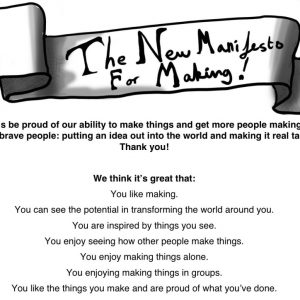
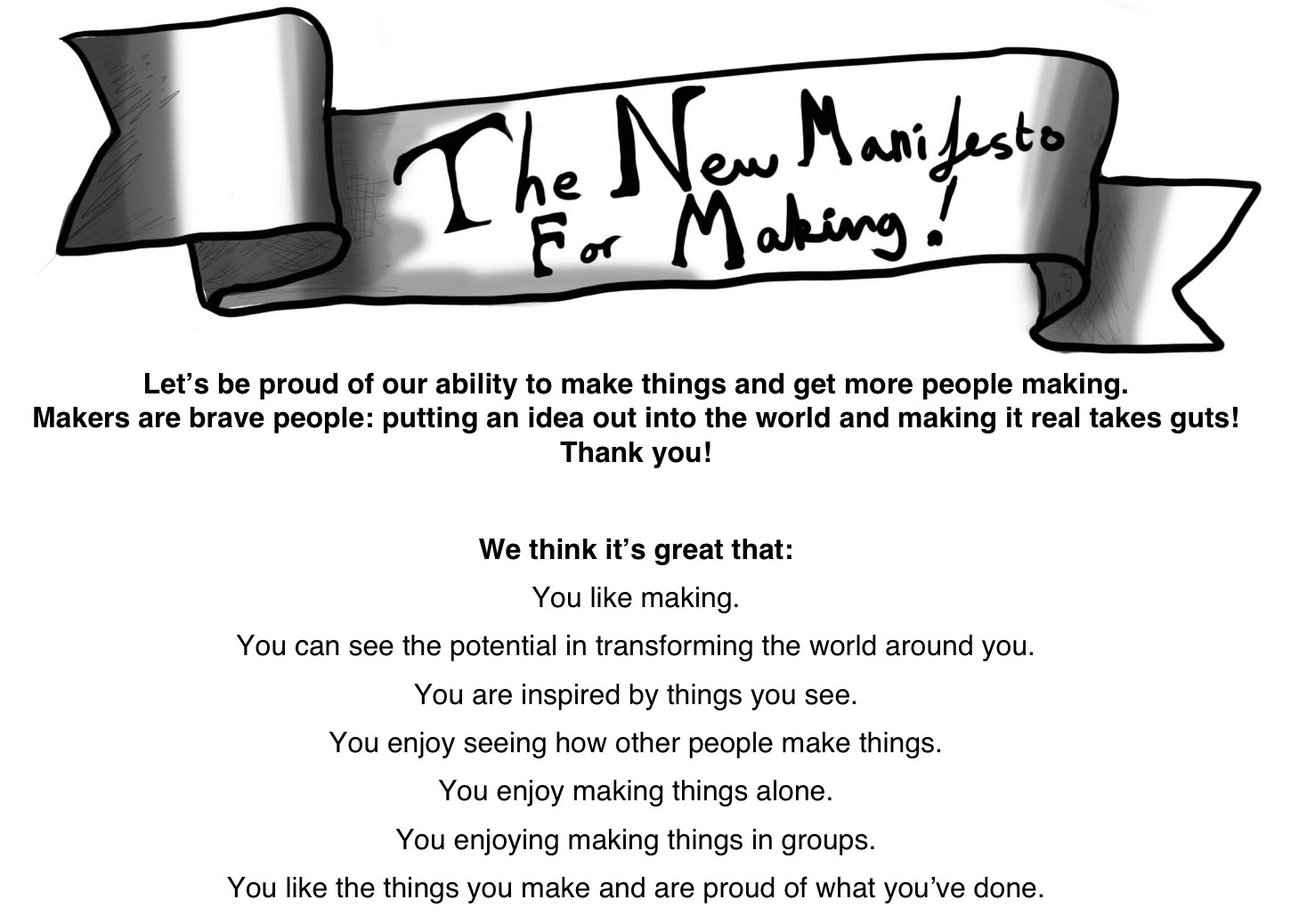
The AccessArt New Manifesto for Making
No. 1 Quality of Experience
First of all, we need to be brave. Because we want to defend art, I think sometimes it’s hard for us to admit that actually we have a lot of art in schools across the country which is not well taught. We need to recognise that not all art teaching is actually worth defending. That was really hard for me to write, and I do not like to criticise, and I certainly do not mean to criticise those who are teaching. There is a great deal of very good (outstanding) teaching in art, and lots of average teaching in art. We recognise the reasons for the (well-meant) but less-than-great teaching in art is often due to lack of specialist teachers and lack of training opportunities for those involved, as well as time and money pressures. BUT, until we raise standards in art teaching, across the board, then it will be hard for us to always defend the importance of art in schools, and the opportunities for children to make will continue to decline:
So, putting aside the teaching which is already outstanding, we need to concentrate on making sure that all art in schools is taught with as much rigour as any other subject. I certainly don’t mean rigorously assessed and didactically delivered. There are many creative ways to teach rigorously. A lot of the making which takes place in schools is not of a good enough quality: there is an underestimation of what kind of materials and tools children can use, and of the kind of creative journey children are capable of. Making is often too easy, too controlled, too limited in scope and vision and the outcomes too closed and poor. And when we don’t respect the process of making, we drive the subject into a corner which we can easily get rid of: we talk ourselves out of the activity. We can do with out it. Gone.
So No.1, we need to work together to raise quality in art education – right from the youngest primary school children. What if:
- We ASPIRE to deliver the best facilitation we can, wherever it takes place;
- We REVERSE the deskilling of teachers through accessible, cost effective, relevant training (online and physical);
- We SHARE examples of good practice, which is most definitely happening around the country.
NO. 2 Artists CAN transform lives
It’s not that artists make better teachers, but they can make a different kind of teacher, and one which complements existing teaching. What if:
- Artists are encouraged to see their potential as educators? How can we enable artists to recognise their unique skills as communicators, enablers and inspirers?
- Artists see artist in education opportunities as a role to aspire to, not a role to fall back on?
- Every artist works with a group of children and changes lives one child at a time?
- It turns out that artists can save the world?
No. 3 Empowering parents to ask
Parents feel enabled to contact their child’s school if they have concerns about maths, english, friendship problems… What if:
- Parents understand the importance and gravity of the lack of making in their child’s school week? Not just to potential artists and makers, but also to architects, builders, plumbers, engineers, scientists, surgeons… anyone who exists in the physical world (all of us), those who aren’t motivated or feel included by existing lessons, those who are in danger of exclusion, those who struggle socially…
- Parents begin to understand the problem with the disconnect between a school which doesn’t provide opportunities for hands-on experience of the physical world, with high quality creative experience, and the statistics about the cultural economy (at the moment parents are not aware of the disconnect);
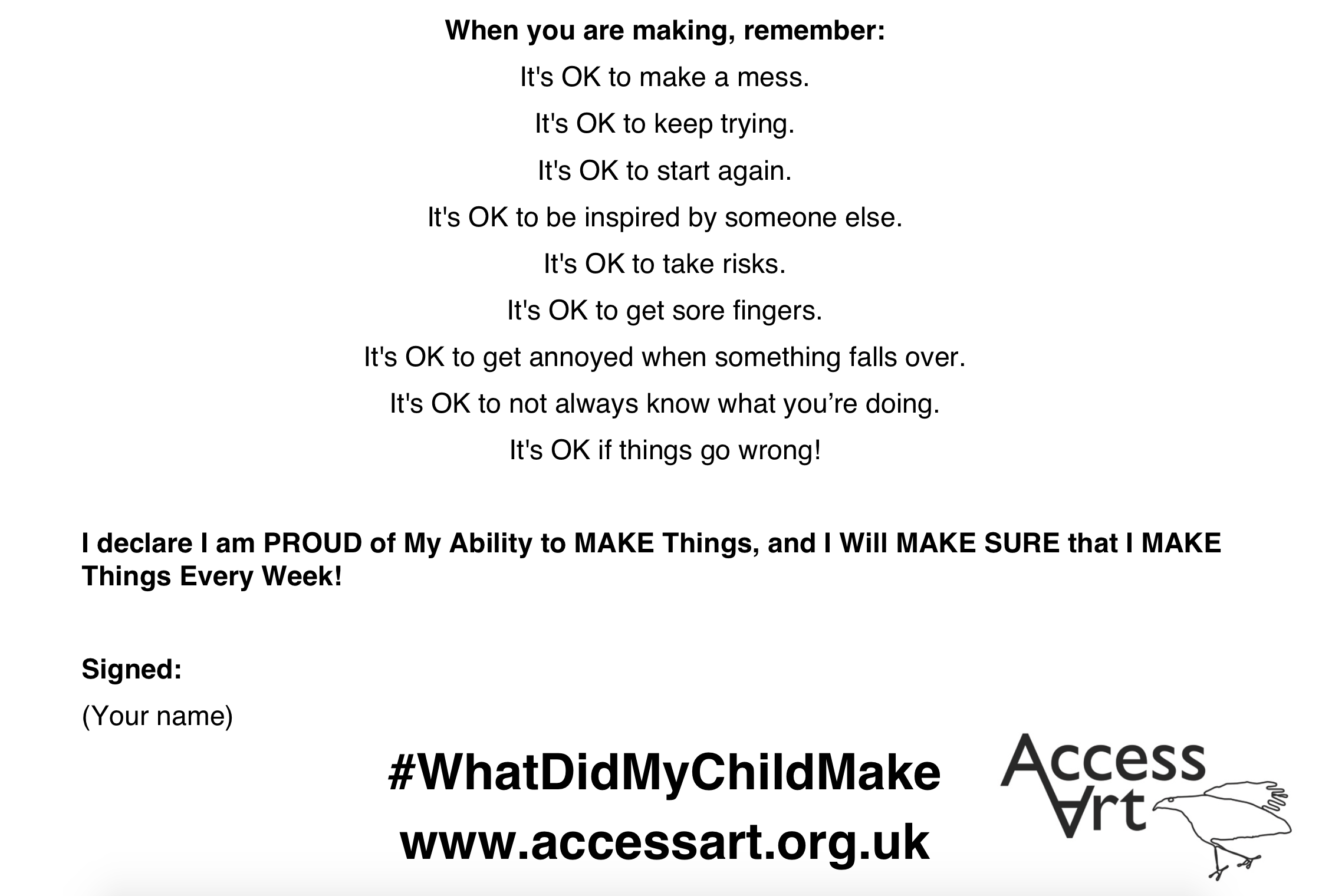
- Parents feel able to ask of the school the simple question “What did my child make with their hands this week?”
No. 4 Telling children it’s more than OK…
We all need someone to give us permission to make:
You May Also Like…
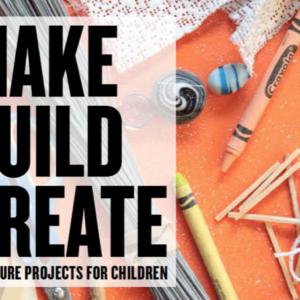
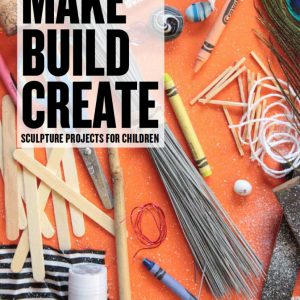
Make, Build, Create: Sculpture Projects for Children by Paula Briggs
Published by Black Dog Books
#WHATDIDMYCHILDMAKE
A collection of resources to consider how you can increase opportunities for making
Be a Resource Contributor

AccessArt is a unique organisation!
We work in collaboration with artists, educators, schools, museums, galleries and arts organisations to create inspirational visual arts resources.
Find out how you can be an AccessArt resource contributor below.
Please contact content@accessart.org.uk for more information.

A big part of what makes AccessArt special is the evolving collection of unique resources which form a huge pot of inspiration for our users.
As well as inspiring others, these resources also serve to highlight artist educator practice, providing a ‘shop window’ for your work so that you can reach new audiences and find new work. They also help provide a legacy home for projects which might otherwise not get shared quite so effectively.
Resource contributors can live in the UK or overseas. You might be working alone, in partnership or with another organisation. Wherever possible we try to ensure contributors are paid for their contribution.
find our more…
Information for Artist Educators
Find out how to propose a resource if you are an Artist Educator.
See all current contributors
See the creative practitioners and artist educators who have created posts for AccessArt.
Two Beautiful Books to Inspire Teaching & Learning
Drawing Projects for Children and Make Build Create aim to inspire and enable children, teachers, facilitators and workshop leaders to explore drawing and sculpture in an active and adventurous way.
Find further details about each book, including reviews, below.
*The exercises and projects in these books are aimed at children aged 5 to 12, however the majority of the projects can easily be adapted for older pupils and adults too.
Drawing Projects for Children
Make, Build, Create: Sculpture Projects for Children
Published by Black Dog Press
Ros Corser
Make Build Create by Paula Briggs is an informative and helpful manual that describes a series of creative sculptural projects designed to engage all. Beautiful photographs run throughout the book, making it as visually appealing as it is inspiring. Thank you, Paula, for such an inspirational book, encouraging “hands-on art” for everyone.
Amanda Warren, NSEAD Network
Make, Build, Create is an inspiring book. Like its predecessor ‘Drawing Projects for Children’, it is beautifully produced, with beguiling photographs and a carefully laid out task which is easy to access whilst being packed with inspiration.
Based on the premise that children love to make things but probably are given insufficient opportunity, the book guides the reader through some basic premises (such as “Why make?”) and useful information about equipment and safe procedures. Some of the materials suggested may have been neglected in recent years (I confess it is a long time since I used plaster in powder form), and there are zany ideas, too. Making a plinth for a figure looks sure to appeal! And those wire insects! The photos can easily be shared with a group of children to inspire them or to illustrate processes.
My only query is who the book is aimed at. To begin with, I thought it was a book for children, but the foreword is definitely for teachers and facilitators. But does it really matter? The book is sumptuous, gorgeous, and appealing. Paula Briggs has done it again; let’s get making!
Amanda Morris-Drake, Darwin Centre for Young People
Full of excellent ideas and beautifully presented.
AccessArt & The Guardian
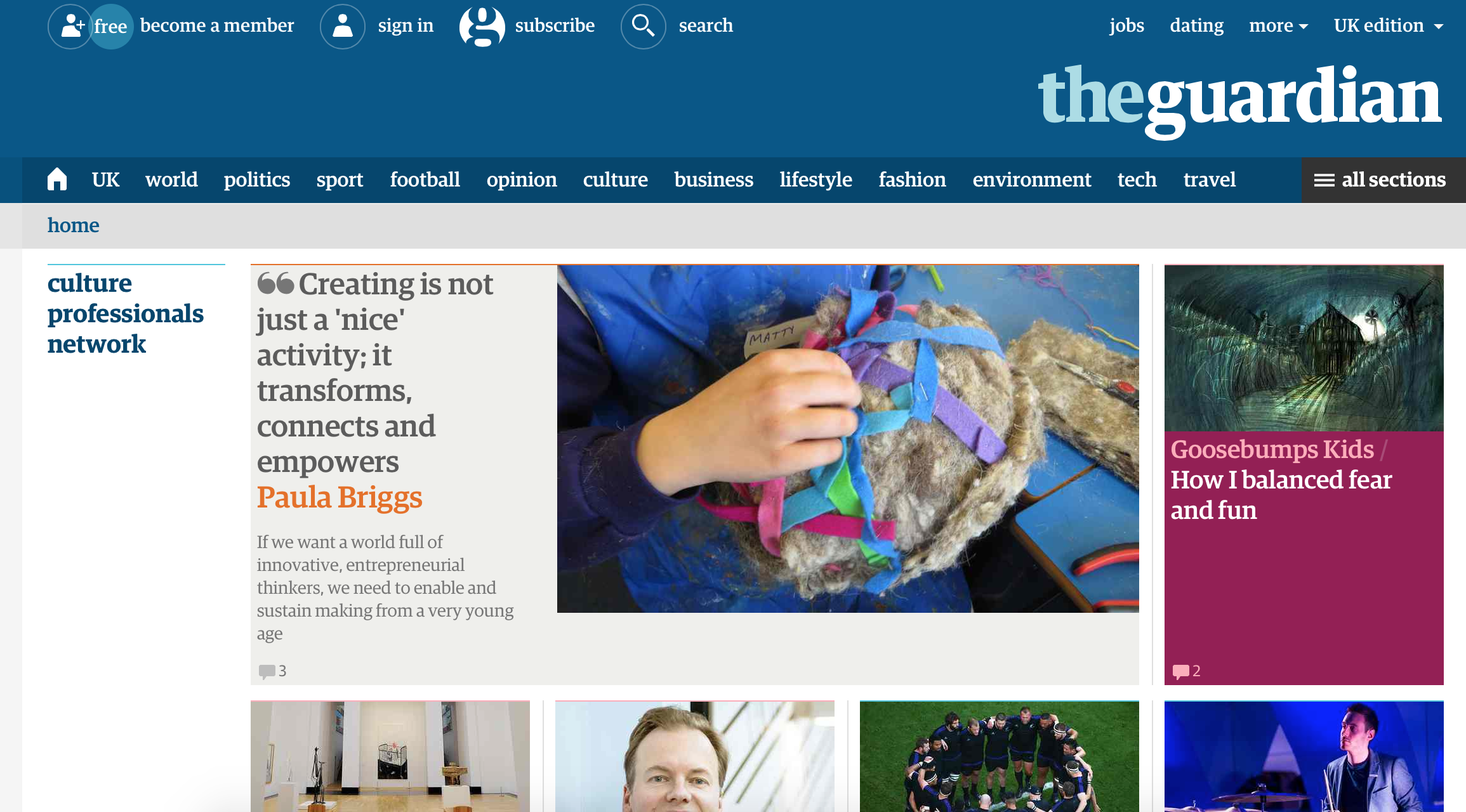
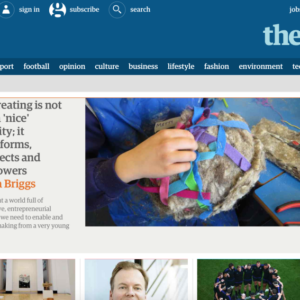
“If we want a world full of innovative, entrepreneurial thinkers, we need to enable and sustain making from a very young age”
Paula Briggs from AccessArt writes about the importance enabling making in schools.